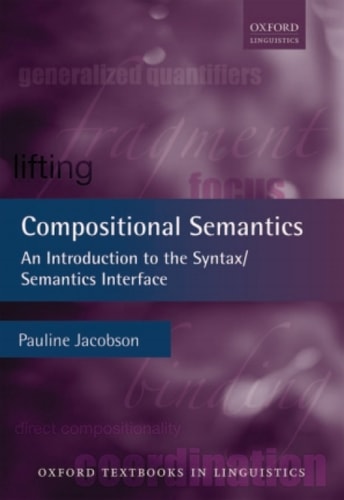
Compositional Semantics: An Introduction to the Syntax/Semantics Interface
0
0
As an Amazon Associate and affiliate partner, Menrva Books earns from qualifying purchases. Learn more
Author Description
This book provides an introduction to compositional semantics and to the syntax/semantics interface. It is rooted within the tradition of model theoretic semantics, and develops an explicit fragment of both the syntax and semantics of a rich portion of English. Professor Jacobson adopts a Direct Compositionality approach, whereby the syntax builds the expressions while the semantics simultaneously assigns each a model-theoretic interpretation. Alongside this approach, the author also presents a competing view that makes use of an intermediate level, Logical Form. She develops parallel treatments of a variety of phenomena from both points of view with detailed comparisons. The book begins with simple and fundamental concepts and gradually builds a more complex fragment, including analyses of more advanced topics such as focus, negative polarity, and a variety of topics centering on pronouns and binding more generally. Exercises are provided throughout, alongside open-ended questions for students to consider. The exercises are interspersed with the text to promote self-discovery of the fundamentals and their applications. The book provides a rigorous foundation in formal analysis and model theoretic semantics and is suitable for advanced undergraduate and graduate students in linguistics, philosophy of language, and related fields.
Menrva's Summary
THE THESIS
This text investigates the mechanisms of compositional semantics and the structural interface between syntax and semantic interpretation. Pauline Jacobson, a professor of linguistics, utilizes the framework of model-theoretic semantics to construct an explicit fragment of English. The book evaluates the Direct Compositionality approach against the alternative model of Logical Form, providing a comparative analysis of how linguistic expressions are generated and interpreted.
THE SCOPE MAP
What You Will Find
- Model-theoretic semantics and Direct Compositionality methodology
- Comparative analysis of Direct Compositionality versus Logical Form
- Technical treatments of focus, negative polarity, and pronoun binding
- Pedagogical exercises and open-ended inquiry questions
Scope Limits
- Does not cover non-formalist or cognitive-functional approaches to semantics
- Focuses primarily on English syntax rather than cross-linguistic typology
THE AUTHORITY PERSPECTIVE
Experts recognize this work as a rigorous foundational text for advanced students in linguistics and the philosophy of language. Readers frequently note the high level of technical density, which requires a solid background in formal logic and syntactic theory to navigate effectively.
Page Count:
448
Publication Date:
2014-01-01
Publisher:
OUP Oxford
ISBN-10:
0191664839
ISBN-13:
9780191664830
Syntax
Academic Textbooks
Semantics
English & College Success
Philosophy of
English
Linguistics
Community Tags
Similar Books