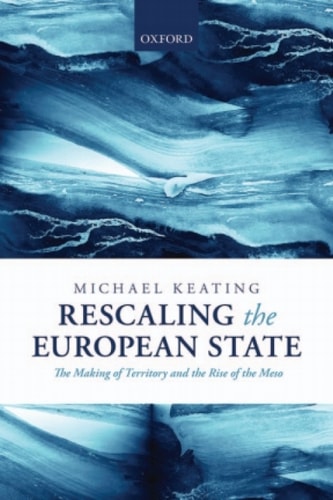
Rescaling the European State: The Making of Territory and the Rise of the Meso
0
0
As an Amazon Associate and affiliate partner, Menrva Books earns from qualifying purchases. Learn more
Author Description
Social scientists have regularly proclaimed the end of territory under successive waves of modernization, yet it continually re-emerges as a key principle of social, economic, and political organization. Rather than a de-territorialization we are witnessing a rescaling of social life as functional systems, identities, and political expression migrate to new levels. This is not new, but is a recurrent feature of the European state. States have sought to reassert control over these new spaces, while political and social movements have sought to politicize them and open them up to popular influence. The result has been the emergence of the meso-level or region as set of contested spaces, and increasingly as a level of government. Social and economic interests are refracted at these new territorial levels to reshape the policy agenda and create new social alliances and conflicts. Regions have emerged as spaces for public policy, with significant divergences over economic development, welfare policies, public services and environmental issues. Rescaling poses important normative questions about self-determination and social solidarity. These cannot definitively be resolved but are reframed, with new forms of self-government being possible and social solidarity emerging at new levels. Competitive regionalism has become a dominant theme but there is no generalized race to bottom as regions respond to the challenge in multiple ways. Regions are not going to replace the nation-state as they remain loosely-bounded and contested spaces but territory continues to reshape European polities. Drawing on a rich interdisciplinary literature and on original research, the volume provides a fresh and engaging analytical approach to the understanding of territory and power in contemporary Europe.
Menrva's Summary
THE THESIS
This book investigates how the traditional concept of territory is being rescaled within the European state, rather than disappearing, to create new meso-level political and social spaces. Michael Keating, a scholar of regional politics and European integration, utilizes an interdisciplinary framework to analyze how functional systems and political identities migrate to regional levels. He argues that this rescaling process is a recurrent feature of state development, where states and social movements compete to define and control these emerging territorial spaces.
THE SCOPE MAP
What You Will Find
- Analysis of the meso-level region as a site of government and policy formation.
- Examination of competitive regionalism and its impact on welfare and economic development.
- Theoretical framework regarding the relationship between territory, power, and social solidarity.
Scope Limits
- The text does not provide a comprehensive history of every individual European region.
- It does not offer a definitive resolution to the normative questions of self-determination.
THE AUTHORITY PERSPECTIVE
Experts recognize this work as a significant contribution to the study of territorial politics and the evolution of the European state. Readers frequently note the academic density of the prose and the author's ability to synthesize complex interdisciplinary research into a coherent analytical model.
Page Count:
232
Publication Date:
2013-01-01
Publisher:
OUP Oxford
ISBN-10:
0191663638
ISBN-13:
9780191663635
Sociology
Geography
Comparative Politics
Regionalism
Public Policy
Community Tags
Similar Books