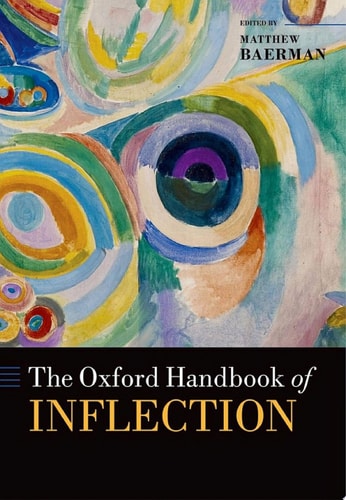
The Oxford Handbook of Inflection
0
0
As an Amazon Associate and affiliate partner, Menrva Books earns from qualifying purchases. Learn more
Author Description
This is the latest addition to a group of handbooks covering the field of morphology, alongside The Oxford Handbook of Case (2008), The Oxford Handbook of Compounding (2009), and The Oxford Handbook of Derivational Morphology (2014). It provides a comprehensive state-of-the-art overview of work on inflection - the expression of grammatical information through changes in word forms. The volume's 24 chapters are written by experts in the field from a variety of theoretical backgrounds, with examples drawn from a wide range of languages. The first part of the handbook covers the fundamental building blocks of inflectional form and content: morphemes, features, and means of exponence. Part 2 focuses on what is arguably the most characteristic property of inflectional systems, paradigmatic structure, and the non-trivial nature of the mapping between function and form. The third part deals with change and variation over time, and the fourth part covers computational issues from a theoretical and practical standpoint. Part 5 addresses psycholinguistic questions relating to language acquisition and neurocognitive disorders. The final part is devoted to sketches of individual inflectional systems, illustrating a range of typological possibilities across a genetically diverse set of languages from Africa, Asia and the Pacific, Australia, Europe, and South America.
Menrva's Summary
THE THESIS
This volume investigates the mechanisms of inflection, specifically how grammatical information is expressed through variations in word forms across diverse linguistic systems. Edited by Matthew Baerman, the handbook compiles research from international experts to provide a comprehensive state-of-the-art overview of the field. It utilizes a multi-disciplinary approach, integrating theoretical morphology with computational, psycholinguistic, and typological perspectives to map the current understanding of inflectional systems.
THE SCOPE MAP
What You Will Find
- Analysis of fundamental building blocks including morphemes, features, and exponence.
- Examination of paradigmatic structures and the mapping between function and form.
- Discussion of diachronic change, variation, and computational modeling of inflection.
- Psycholinguistic insights into language acquisition and neurocognitive processing.
- Typological sketches covering languages from Africa, Asia, the Pacific, Australia, Europe, and South America.
Scope Limits
- The text focuses primarily on inflectional morphology and does not provide an exhaustive treatment of syntax or semantics outside of their direct relation to word-form changes.
THE AUTHORITY PERSPECTIVE
Experts identify this volume as a foundational reference work for advanced students and researchers in theoretical linguistics. Readers frequently note the academic density of the prose, which is designed for those already familiar with morphological terminology and linguistic theory.
Page Count:
689
Publication Date:
2015-01-01
Publisher:
OUP Oxford
ISBN-10:
0191664944
ISBN-13:
9780191664946
Grammar
Morphology
English & College Success
Academic
Reference
English
Linguistics
Community Tags
Other Editions(4)


Similar Books