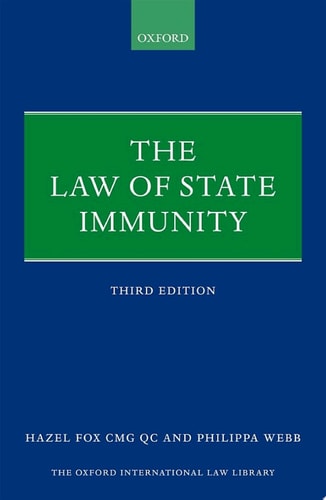
The Law of State Immunity
0
0
As an Amazon Associate and affiliate partner, Menrva Books earns from qualifying purchases. Learn more
Author Description
The doctrine of state immunity bars a national court from adjudicating or enforcing claims against foreign states. This doctrine, the foundation for high-profile national and international decisions such as those in the Pinochet case and the Arrest Warrant cases, has always been controversial. The reasons for the controversy are many and varied. Some argue that state immunity paves the way for state violations of human rights. Others argue that the customary basis for the doctrine is not a sufficient basis for regulation and that codification is the way forward. Furthermore, it can be argued that even when judgments are made in national courts against other states, the doctrine makes enforcement of these decisions impossible. This fully restructured new edition provides a detailed analysis of these issues in a more clear and accessible manner. It provides a nuanced assessment of the development of the doctrine of state immunity, including a general comprehensive overview of the plea of immunity of a foreign state, its characteristics, and its operation as a bar to proceedings in national courts of another state. It includes a coherent history and justification of the plea of state immunity, demonstrating its development from the absolute to the restrictive phase, arguing that state immunity can now be seen to be developing into a third phase which uses immunity allocate adjudicative and enforcement jurisdictions between the foreign and the territorial states. The United Nations Convention on Jurisdictional Immunities of states and their Property is thoroughly assessed. Through a detailed examination of the sources of law and of English and US case law, and a comparative analysis of other types of immunity, the authors explore both the law as it stands, and what it could and should be in years to come.
Menrva's Summary
THE THESIS
This book investigates the legal doctrine of state immunity, questioning how it balances the sovereignty of foreign states against the adjudicative and enforcement powers of national courts. Hazel Fox and Philippa Webb, both distinguished legal scholars, provide a comprehensive analysis of the doctrine's evolution from absolute to restrictive phases. They argue that the law is currently transitioning into a third phase, which functions to allocate jurisdictional authority between territorial and foreign states while addressing the tensions between immunity and human rights obligations.
THE SCOPE MAP
What You Will Find
- Analysis of the United Nations Convention on Jurisdictional Immunities of States and their Property
- Historical development of state immunity from absolute to restrictive models
- Comparative analysis of English and US case law
- Examination of the intersection between immunity and human rights violations
Scope Limits
- The text focuses primarily on the legal doctrine of state immunity and does not provide an exhaustive survey of all forms of diplomatic or sovereign immunity.
THE AUTHORITY PERSPECTIVE
Legal scholars and practitioners frequently cite this work as a definitive reference for understanding the complexities of jurisdictional immunity in international law. Experts highlight the authors' ability to synthesize dense case law into a coherent framework for both academic study and practical application.
Page Count:
691
Publication Date:
2013-01-01
Publisher:
OUP Oxford
ISBN-10:
0191669768
ISBN-13:
9780191669767
Professional Career & Trade
Jurisprudence
International Law
Human rights
Law
Community Tags
Similar Books