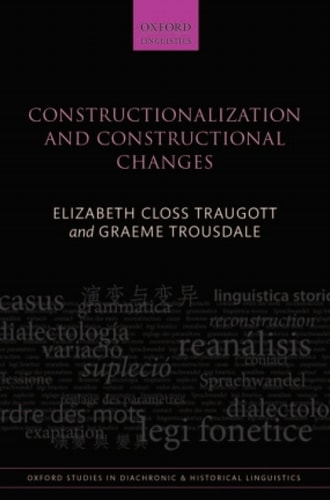
Constructionalization and Constructional Changes
0
0
As an Amazon Associate and affiliate partner, Menrva Books earns from qualifying purchases. Learn more
Author Description
Elizabeth Closs Traugott and Graeme Trousdale develop an approach to language change based on construction grammar. Construction grammar is a theory of signs construed at the level of the phrase, clause, and complex sentence. Until now it has been mainly synchronic. The authors use it to reconceptualize grammaticalization (the process by which verbs like to have lose semantic content and gain grammatical functions, or word order moves from discourse-prominent to syntax-prominent), and lexicalization (in which idioms become fixed and complex words simplified). Basing their argument on the notions that language is made up of language-specific form-meaning pairings and that there is a gradient between lexical and grammatical constructions, Professor Traugott and Dr Trousdale suggest that language change proceeds by micro-steps that involve closely related changes in syntax, morphology, phonology, semantics, pragmatics, and discourse functions. They illustrate their exposition with numerous English examples drawn from Anglo-Saxon times to the present, many of which they discuss in depth. The book is organized in six chapters. The first outlines the approach and the questions to be addressed. The second reviews usage-based models of language change. The third considers the relation between grammatical constructionalization and grammaticalization. Chapters 4 and 5 focus respectively on lexical constructionalization and the role of context. The final chapter draws the authors' arguments together and outlines prospects for further research. Constructionalization and Constructional Changes propounds and demonstrates a new and productive approach to historical linguistics.
Menrva's Summary
THE THESIS
This book investigates how language change can be systematically explained through the framework of construction grammar. Elizabeth Closs Traugott and Graeme Trousdale, both established scholars in historical linguistics, propose that language change occurs through micro-steps involving form-meaning pairings. By applying constructional analysis to historical data, they argue that grammaticalization and lexicalization are not isolated phenomena but are part of a continuous gradient of constructional change.
THE SCOPE MAP
What You Will Find
- A theoretical framework for diachronic construction grammar
- Analysis of the relationship between grammaticalization and constructionalization
- Examination of lexical constructionalization and contextual influence
- Extensive English language data spanning from the Anglo-Saxon period to the present
Scope Limits
- The text focuses primarily on English language examples
- It does not provide a comprehensive history of all linguistic theories, focusing instead on construction-based models
THE AUTHORITY PERSPECTIVE
Experts recognize this work as a significant contribution to the development of diachronic construction grammar. Readers frequently note the academic density of the prose, which is intended for advanced students and researchers in the field of linguistics.
Page Count:
304
Publication Date:
2013-01-01
Publisher:
OUP Oxford
ISBN-10:
0191669490
ISBN-13:
9780191669491
Academic
Historical linguistics
Linguistics
English
Grammar
English & College Success
Diachronic Linguistics
Community Tags
Other Editions(4)


Similar Books




Reader Comments
Share Your Thoughts
No comments yet. Be the first to share your thoughts!