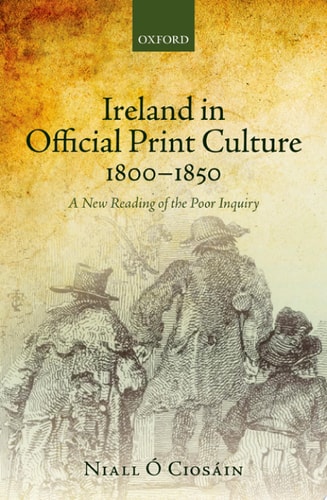
Ireland in Official Print Culture, 1800-1850: A New Reading of the Poor Inquiry
0
0
As an Amazon Associate and affiliate partner, Menrva Books earns from qualifying purchases. Learn more
Author Description
The decades after 1800 saw a fundamental redefinition of the role of the state in Ireland. Many of the most pervasive and enduring forms of official intervention and regulation date from this period, such as a permanent centralised police force, a system of elementary education, a network of small courts, and a national system of poor relief. Many of these were preceded by large-scale official investigations whose results were published as parliamentary reports, another novel aspect of state activity. The book analyses the construction and dissemination of an official image of Irish society in those reports. It takes as its principal example a state inquiry into poverty: the largest social survey of Ireland: lasting from 1833 to 1836, running to thousands of pages, and offering a unique insight into pre-famine society and official perceptions of it. This volume also illuminates two other contemporary aspects of the development of the state. The 1820s saw the beginning in Ireland of a comprehensive engagement with the parliamentary process by the population at large, with the appearance of the first mass electoral organisation in Europe, the Catholic Association. Finally, the Union of 1801 meant that Irish legislation was now discussed and enacted in Britain rather than in Ireland, and by a parliament and public newly informed by official reports on Ireland. This was therefore a crucial period in the construction of the public understanding of Ireland in both Britain and Ireland, a process in which the state and its publications played a fundamental role.
Menrva's Summary
THE THESIS
This book investigates how the British state utilized official parliamentary reports to construct and disseminate a specific image of Irish society between 1800 and 1850. Niall Ó Ciosáin, a historian specializing in Irish social and cultural history, examines the intersection of state-building and public perception. By analyzing the massive 1833-1836 Poor Inquiry, the author argues that these administrative documents were not merely neutral data collection efforts but active tools in shaping the political and social understanding of Ireland during a period of significant legislative transition.
THE SCOPE MAP
What You Will Find
- Analysis of the 1833-1836 Poor Inquiry as a primary source for pre-famine Irish social conditions.
- Examination of the development of centralized state institutions including police, education, and poor relief.
- Discussion of the impact of the 1801 Act of Union on legislative processes and public discourse.
- Contextualization of the Catholic Association and the rise of mass electoral organization.
Scope Limits
- The study focuses primarily on official print culture and state-produced reports rather than private or non-official literature.
- The analysis is geographically and temporally bounded by the Irish experience within the British parliamentary framework from 1800 to 1850.
THE AUTHORITY PERSPECTIVE
Scholars of Irish history recognize this work as a significant contribution to understanding the administrative and discursive mechanisms of the nineteenth-century British state. Readers frequently note the academic rigor and the author's ability to synthesize complex parliamentary data into a coherent narrative of state formation.
Page Count:
208
Publication Date:
2014-01-01
Publisher:
OUP Oxford
ISBN-10:
0191668710
ISBN-13:
9780191668715
History
European History
Sociology
19th Century
Public Policy
Irish History
Community Tags
Similar Books