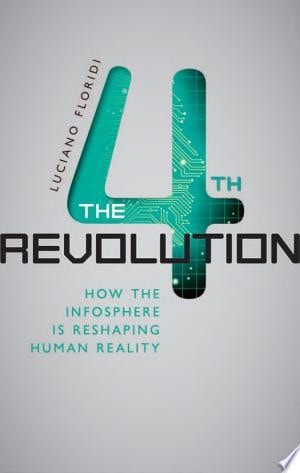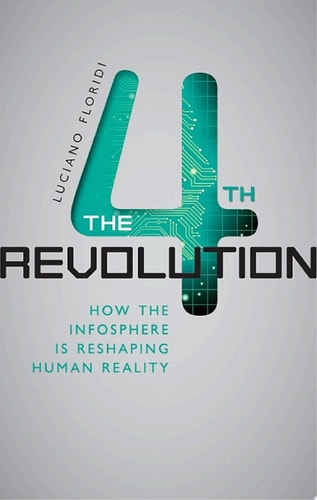
The Fourth Revolution: How the Infosphere is Reshaping Human Reality
0
0
As an Amazon Associate and affiliate partner, Menrva Books earns from qualifying purchases. Learn more
Author Description
Who are we, and how do we relate to each other? Luciano Floridi, one of the leading figures in contemporary philosophy, argues that the explosive developments in Information and Communication Technologies (ICTs) is changing the answer to these fundamental human questions. As the boundaries between life online and offline break down, and we become seamlessly connected to each other and surrounded by smart, responsive objects, we are all becoming integrated into an "infosphere". Personas we adopt in social media, for example, feed into our 'real' lives so that we begin to live, as Floridi puts in, "onlife". Following those led by Copernicus, Darwin, and Freud, this metaphysical shift represents nothing less than a fourth revolution. "Onlife" defines more and more of our daily activity - the way we shop, work, learn, care for our health, entertain ourselves, conduct our relationships; the way we interact with the worlds of law, finance, and politics; even the way we conduct war. In every department of life, ICTs have become environmental forces which are creating and transforming our realities. How can we ensure that we shall reap their benefits? What are the implicit risks? Are our technologies going to enable and empower us, or constrain us? Floridi argues that we must expand our ecological and ethical approach to cover both natural and man-made realities, putting the 'e' in an environmentalism that can deal successfully with the new challenges posed by our digital technologies and information society.
Menrva's Summary
THE THESIS
Luciano Floridi investigates how the rapid evolution of Information and Communication Technologies (ICTs) constitutes a fourth revolution that fundamentally alters human identity and our relationship with reality. Drawing on his background as a professor of philosophy and ethics of information, Floridi posits that humanity has transitioned into an 'infosphere' where the distinction between online and offline existence has dissolved. He argues that this 'onlife' state requires a new ethical and ecological framework to manage the transformative power of digital environments on human society and individual agency.
THE SCOPE MAP
What You Will Find
- A conceptual framework defining the 'infosphere' and the 'onlife' experience.
- An analysis of the historical context of metaphysical shifts initiated by Copernicus, Darwin, and Freud.
- An examination of how ICTs influence diverse sectors including law, politics, finance, and warfare.
- A proposal for an expanded ethical approach to environmentalism that incorporates man-made digital realities.
Scope Limits
- The text does not provide technical manuals for specific software or hardware implementation.
- The analysis focuses on philosophical and societal implications rather than granular economic forecasting.
THE AUTHORITY PERSPECTIVE
Scholars and critics frequently identify this work as a foundational text for understanding the intersection of digital technology and contemporary philosophy. Readers often note the academic density of the prose, which requires careful engagement with the author's specialized terminology regarding information ethics.
Page Count:
264
Publication Date:
2014-01-01
Publisher:
OUP Oxford
ISBN-10:
0191667706
ISBN-13:
9780191667701
History
Philosophy
Ethics
Computers and civilization
Information society
Sociology
Earth Sciences
Information Theory
Internet
Technology