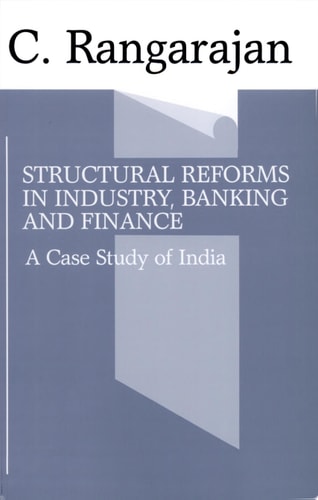
Structural Reforms in Industry, Banking and Finance: A Case Study of India
0
0
As an Amazon Associate and affiliate partner, Menrva Books earns from qualifying purchases. Learn more
Author Description
The year 1991 marked an important watershed in the economic history of post-Independent India. The country went through a severe economic crisis triggered by a serious balance of payments situation. The crisis was converted into an opportunity to introduce some fundamental changes in the content and approach to economic policy. The purpose of this book is to detail the structural reform process undertaken by India and to evaluate its results. In the post-liberalization period, the country has moved to a higher growth path. Objective conditions exist for the economy to grow at a sustained rate of seven per cent. The slow growth in agriculture and the consequent impact of a slower decline in poverty reduction are areas of concern.
Menrva's Summary
THE THESIS
This book details the structural reform process undertaken by India in the wake of the 1991 economic crisis and evaluates its results. In the post-liberalization period, India has moved to a higher growth path, with objective conditions existing for the economy to grow at a sustained rate of seven percent. However, the slow growth in agriculture and its consequent impact on poverty reduction remain areas of concern. The book aims to provide a comprehensive analysis of these significant economic shifts.
THE SCOPE MAP
- Detailed account of the structural reform process in India post-1991.
- Evaluation of the results and impact of these reforms on the Indian economy.
- Analysis of the shift to a higher growth path and sustained growth potential.
- Discussion of concerns regarding slow agricultural growth and poverty reduction.
- Insights from C. Rangarajan, a key figure in India's economic policy.
THE AUTHORITY PERSPECTIVE
The book provides a detailed analysis of India's economic reforms following the 1991 crisis, highlighting the transition to a higher growth trajectory. It acknowledges the positive developments while also pointing to persistent challenges in agriculture and poverty reduction. The work is likely to be of interest to economists, policymakers, and students of economic history.
Page Count:
61
Publication Date:
2000-01-01
Publisher:
Institute of Southeast Asian Studies
ISBN-10:
9812301097
ISBN-13:
9789812301093
Business
History
Non-Fiction
Economics
Community Tags
Similar Books














