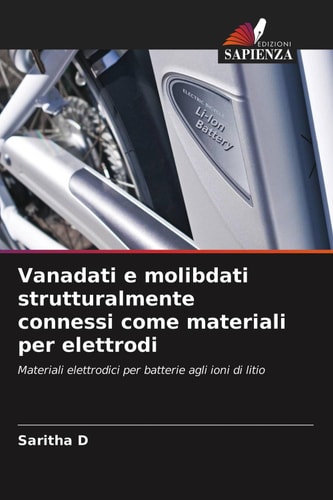
Vanadati e molibdati strutturalmente connessi come materiali per elettrodi: Materiali elettrodici per batterie agli ioni di litio
0
0
As an Amazon Associate and affiliate partner, Menrva Books earns from qualifying purchases. Learn more
Author Description
Questo libro presenta le prestazioni elettrochimiche di tre composti strutturalmente correlati MVMoO7 (M= Fe3+, Cr3+, Al3+) come materiali elettrodici per batterie Li-ion. Si osserva che la tensione corrispondente alle coppie redox V5+/V4+ e Mo6+/Mo5+ sono significativamente diverse per AlVMoO7 rispetto agli analoghi Fe e Cr. Questo studio fornisce la prova conclusiva che la presenza di diversi controcationi nel reticolo (ioni trivalenti in questo caso) influenza l'energetica del processo redox delle specie elettrochimicamente attive. FeVMoO7, CrVMoO7 e AlVMoO7 reagiscono con 3,5 Li, 2,5 Li e 3,3 Li per unità di formula, rispettivamente di cui è possibile l'estrazione reversibile di 2,2 Li, 1,3 Li e 2,6 Li rispettivamente. I risultati degli studi ciclistici mostrano che le fasi FeVMoO7 e AlVMoO7 esibiscono una capacità reversibile di 160 mAhg-1 e 180 mAhg-1 senza alcun notevole calo di capacità anche dopo 20 cicli. La reversibilità della reazione del Li è più facile in AlVMoO7 rispetto alle altre fasi.
Menrva's Summary
THE THESIS
This book investigates the electrochemical performance of vanadate and molybdate compounds as potential electrode materials for lithium-ion batteries. The research focuses on three structurally related compounds: MVMoO7, where M represents Fe3+, Cr3+, or Al3+. The study highlights significant differences in the redox potentials of V5+/V4+ and Mo6+/Mo5+ pairs between AlVMoO7 and its Fe and Cr counterparts, demonstrating how the presence of different countercations influences the energetics of redox processes in electrochemically active species.
THE SCOPE MAP
- Electrochemical performance analysis of FeVMoO7, CrVMoO7, and AlVMoO7.
- Investigation of redox potentials for V5+/V4+ and Mo6+/Mo5+ couples.
- Determination of lithium insertion/extraction capacities for each compound.
- Reversible lithium extraction of 2.2 Li, 1.3 Li, and 2.6 Li per formula unit for FeVMoO7, CrVMoO7, and AlVMoO7, respectively.
- Cyclability studies showing reversible capacities of 160 mAhg-1 for FeVMoO7 and 180 mAhg-1 for AlVMoO7 after 20 cycles.
- Comparative analysis of lithium reaction reversibility across the different phases.
THE AUTHORITY PERSPECTIVE
This specialized study presents detailed electrochemical data on novel electrode materials for lithium-ion batteries. The findings offer insights into how structural variations, specifically the inclusion of different trivalent cations, impact the energy storage capabilities of vanadate and molybdate compounds. The research provides quantitative performance metrics and comparative analyses that would be of interest to materials scientists and battery engineers.
Page Count:
56
Publication Date:
2021-02-05
Publisher:
Edizioni Sapienza
ISBN-10:
6203286540
ISBN-13:
9786203286540
Science
Non-Fiction
Energy storage
Chemistry
Engineering
Community Tags
Similar Books