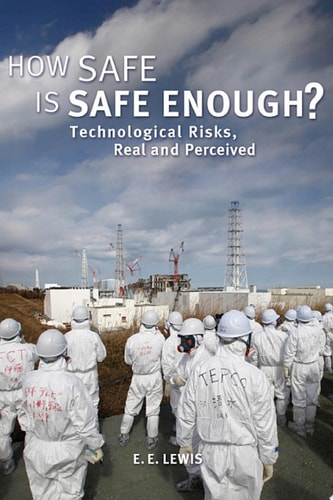
How Safe Is Safe Enough?
0
0
As an Amazon Associate and affiliate partner, Menrva Books earns from qualifying purchases. Learn more
Author Description
Every time an airplane crashes, a gas line explodes, a bridge collapses, or a contaminant escapes the public questions whether the benefits that technology brings are worth its risks. Written in laymen’s language, How Safe Is Safe Enough? explores the realities of the risks that technology presents and the public’s perceptions of them. E. E. Lewis examines how these perceptions are reconciled with economic interests and risk assessors’ analyses in messy and often contentious political processes that determine acceptable levels of safetylevels that often depend more on the perceived nature of the risks than on the number of deaths or injuries that they cause. The author explains why things fail and why design necessitates tradeoffs between performance, cost, and safety. He details methods for identifying and eliminating design flaws and illustrates the consequences when they fail. Lewis examines faulty machine interfaces that cause disastrous human errors and highlights how cost cutting and maintenance neglect have led to catastrophic consequence. How Safe Is Safe Enough? explores how society determines adequate levels of safety, outlining the announcement and enforcement of safety regulations and addressing controversies surrounding cost-benefit analysis. The author argues that large regulatory effects stem from the public’s wide-ranging perceptions of three classes of accidents: the many everyday accidents causing one or two deaths at a time, rare disasters causing large loss of life, and toxic releases leading to uncertain future health risks. The nuclear disaster at Fukushima culminates the discussion, exemplifying the dichotomies faced in reconciling professional risk assessors’ statistical approaches with the citizenry’s fears and perceptions. For better or worse, technology permeates our lives, and much of it we don’t understandhow it works and what the chances are that it will fail dangerously. Such interest and concerns are at the heart of this authoritati
Menrva's Summary
THE THESIS
This book investigates the complex relationship between technological risks, public perception, and the political processes that determine safety regulations. E. E. Lewis, drawing on his expertise, examines how societal fears and economic interests shape our understanding of acceptable risk, often prioritizing the perceived nature of a hazard over statistical data. The book delves into the reasons behind technological failures, the inherent tradeoffs in design between safety, cost, and performance, and the consequences of design flaws, faulty interfaces, and neglected maintenance. It explores the societal mechanisms for establishing and enforcing safety standards, including the controversies surrounding cost-benefit analyses, and uses the Fukushima disaster as a case study to illustrate the conflict between expert assessment and public anxiety.
THE SCOPE MAP
- Analysis of how public perception of technological risks is formed and influenced.
- Examination of the reconciliation between public fears, economic interests, and risk assessors' analyses.
- Explanation of why technological systems fail and the necessity of design tradeoffs.
- Methods for identifying and eliminating design flaws.
- Case studies of disastrous human errors caused by faulty machine interfaces.
- Discussion of the impact of cost-cutting and maintenance neglect on safety.
- Exploration of how society determines adequate safety levels and enforces regulations.
- Analysis of controversies surrounding cost-benefit analysis in safety.
THE AUTHORITY PERSPECTIVE
The book is presented as an accessible exploration of technological risks and public perception, written in laymen's language. It aims to bridge the gap between expert analysis and societal fears, particularly concerning everyday accidents, rare disasters, and toxic releases. The discussion culminates with the Fukushima nuclear disaster, highlighting the dichotomies in reconciling statistical approaches with public apprehension. The author's examination of design tradeoffs, failure mechanisms, and regulatory processes suggests a comprehensive overview for understanding how safety is determined in a technologically advanced society.
Page Count:
256
Publication Date:
2014-10-14
Publisher:
Simon & Schuster
ISBN-10:
1631440160
ISBN-13:
9781631440168
Non-Fiction
Science
Technology
Sociology
Engineering
Community Tags
Similar Books