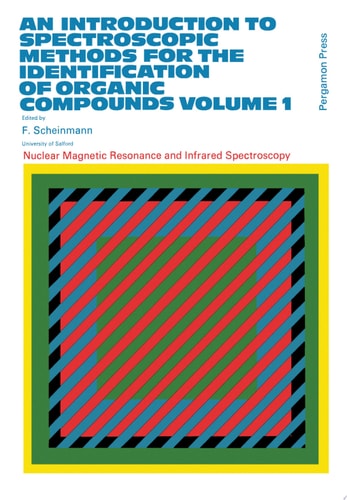
An Introduction to Spectroscopic Methods for the Identification of Organic Compounds: Nuclear Magnetic Resonance and Infrared Spectroscopy
0
0
As an Amazon Associate and affiliate partner, Menrva Books earns from qualifying purchases. Learn more
Author Description
An Introduction to Spectroscopic Methods for the Identification of Organic Compounds, Volume 1: Nuclear Magnetic Resonance and Infrared Spectroscopy discusses how spectral data can be translated into the structural formula of organic compounds and provides reference data and revised correlation tables for the initiated. The text describes high resolution nuclear magnetic resonance spectroscopy; the applications of nuclear magnetic resonance spectroscopy in organic chemistry; and correlation tables for nuclear magnetic resonance spectra. Nuclear magnetic resonance spectroscopy seminar problems and answers; the theoretical basis of infrared spectroscopy; and the applications of infrared spectroscopy to organic chemistry are also encompassed. The book further tackles infrared spectroscopic problems and answers, as well as correlation tables for infrared spectra.
Menrva's Summary
THE THESIS
This book introduces the fundamental principles and applications of Nuclear Magnetic Resonance (NMR) and Infrared (IR) spectroscopy for identifying organic compounds. It aims to equip readers with the ability to translate spectral data into structural formulas, providing essential reference data and correlation tables. The text covers high-resolution NMR spectroscopy, its applications in organic chemistry, and includes seminar problems with solutions. Additionally, it delves into the theoretical basis of IR spectroscopy, its practical uses in organic chemistry, and offers IR spectroscopic problems and corresponding correlation tables.
THE SCOPE MAP
- Detailed explanation of high-resolution Nuclear Magnetic Resonance (NMR) spectroscopy.
- Exploration of the applications of NMR spectroscopy within organic chemistry.
- Provision of reference data and revised correlation tables for NMR spectra.
- Inclusion of NMR spectroscopy seminar problems and their solutions.
- Discussion of the theoretical underpinnings of Infrared (IR) spectroscopy.
- Examination of the applications of IR spectroscopy in organic chemistry.
- Presentation of IR spectroscopic problems and their solutions.
- Inclusion of correlation tables specifically for infrared spectra.
THE AUTHORITY PERSPECTIVE
This text is presented as a foundational resource for understanding spectroscopic methods in organic chemistry. The detailed coverage of both NMR and IR spectroscopy, including theoretical aspects, practical applications, and problem sets with solutions, suggests it is designed for students or researchers seeking to develop proficiency in structural elucidation. The inclusion of reference data and correlation tables indicates a focus on practical utility and serves as a valuable tool for laboratory work and academic study.
Page Count:
212
Publication Date:
2013-10-22
Publisher:
Elsevier
ISBN-10:
1483280772
ISBN-13:
9781483280776
Science
Non-Fiction
Spectroscopy
Organic chemistry
Chemistry
Community Tags
Similar Books