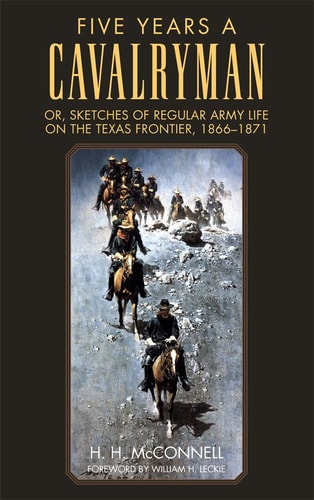
Five Years a Cavalryman Or, Sketches of Regular Army Life on the Texas Frontier, 1866-1871
0
0
As an Amazon Associate and affiliate partner, Menrva Books earns from qualifying purchases. Learn more
Author Description
First published in 1889, H. H. McConnell’s Five Years a Cavalryman remains one of the best accounts of what it was like to be an ordinary cavalryman on the post-Civil War frontier. Posted for five years (1866-1871) with the Sixth U.S. Cavalry at Fort Belknap and Fort Richardson, in West Texas, McConnell gives the unglorified inside story on his fellow enlisted men and the officers, reporting candidly on their heavy drinking, their general disorganization, their boredom, and their thievery. Regarding the Texas Rangers, he admits that they might be tolerable Indian fighters, but in frontier towns, where they would engage in “shooting scrapes and rows” with its citizens and soldiers, they were more a threat to peace than keepers of the same. His tolerant attitude toward Native Americans is evident in his coverage of the arrest and trial of Satanta, Big Tree, and other Kiowas at Fort Sill, in which he grants that General William Sherman’s concurrent visit to the post negatively affected their trial. In the foreword to this edition, William H. Leckie summarizes McConnell’s frontier career and discusses his attitude toward the Tenth Calvary “buffalo soldiers,” the Texas Rangers, and officers such as Colonel Ranald MacKenzie. H. H. McConnell settled in Jacksboro, Texas (where Fort Richardson is located), and became a prominent citizen after his service in the U.S. cavalry. William H. Leckie, who wrote the Foreword, is the author of The Buffalo Soldiers, also published by the University of Oklahoma Press.
Menrva's Summary
THE THESIS
This memoir chronicles the daily realities and candid observations of a U.S. cavalryman stationed on the Texas frontier between 1866 and 1871. H. H. McConnell, a member of the Sixth U.S. Cavalry, provides an unvarnished account of life at Fort Belknap and Fort Richardson, detailing the disorganization, boredom, and personal habits of both enlisted men and officers. His narrative also offers a nuanced perspective on interactions with Native American tribes, particularly during the trial of Kiowa leaders, and critically assesses the role of the Texas Rangers in maintaining frontier peace.
THE SCOPE MAP
- First-hand accounts of daily life for cavalry soldiers on the Texas frontier, 1866-1871.
- Candid reporting on the behavior of fellow enlisted men and officers, including issues of drinking, disorganization, and thievery.
- Observations on the Texas Rangers and their role in frontier towns.
- A detailed account of the arrest and trial of Kiowa leaders Satanta and Big Tree, with commentary on external influences on the proceedings.
- Insights into the author's perspective on Native American relations and the 'buffalo soldiers' of the Tenth Cavalry.
- A foreword by William H. Leckie summarizing McConnell's career and attitudes.
THE AUTHORITY PERSPECTIVE
This memoir is regarded as one of the most authentic and candid accounts of ordinary cavalry life on the post-Civil War Texas frontier. Readers and historians alike value McConnell's unvarnished reporting on the daily routines, challenges, and interpersonal dynamics within the cavalry regiments. His balanced perspective, particularly concerning Native American interactions and the controversial role of the Texas Rangers, contributes significantly to the historical record. The inclusion of a foreword by historian William H. Leckie further contextualizes McConnell's experiences and their significance within the broader narrative of the American West.
Page Count:
311
Publication Date:
1996-02-01
Publisher:
University of Oklahoma Press
ISBN-10:
0806128178
ISBN-13:
9780806128177
Memoir
Non-Fiction
History
Texas history
Military History
Community Tags
Similar Books