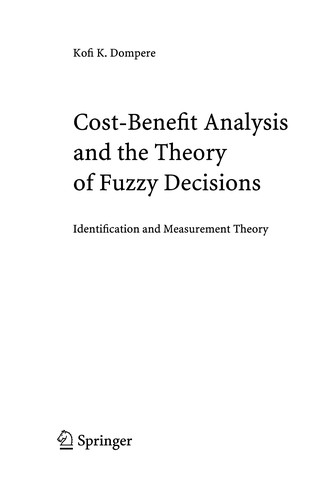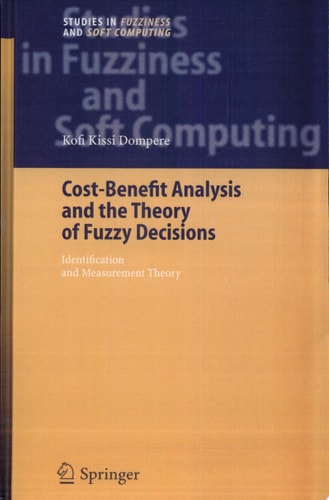
Cost-Benefit Analysis and the Theory of Fuzzy Decisions: Identification and Measurement Theory
0
0
As an Amazon Associate and affiliate partner, Menrva Books earns from qualifying purchases. Learn more
Author Description
The genus of definitions for the theoretical sciences is (the province of) the habitus of the intellective intention, for the practical sciences, however, that of the effective intention; the objects and ends constitute the specific differ ence There is nothing in the intellect that has not already been in the senses, that is, in the sensory organs, that has not already been in sensible things from which are distinguished things not perceptible to the senses. Nothing can be of the mind, sensation and the thing inferred therefrom except the operation itself. Real learning is cognition of things in themselves. It thus has the basis of its certainty in the known thing. This is established in two ways: by demon stration in the case of contemplative things, and by induction in the case of things perceptible to the senses. In contrast with real learning there is pos sible, probable and fictive learning. Antonius Gvilielmus Amo Afer (1827) This research has been long in the making. Its conception began in my last years in the doctoral program at Temple University, Philadelphia, Pa. It was simultaneously conceived with my two books on the Neo Keynesian Theory of Optimal aggregate investment and output dynamics [201] [202] as well as reflections on the methodology of decision-choice rationality and development economics [440] [441]. Economic theories and social policies were viewed to have, among other things, one impor tant thing in common in that they relate to decision making under different.
Menrva's Summary
THE THESIS
This book investigates the theoretical underpinnings of decision-making, particularly in contexts involving uncertainty and imprecision. The author, K. K. Dompere, draws upon his extensive work in economic theory and decision science, building upon his previous publications on Neo-Keynesian economics and development economics. The research explores the relationship between theoretical sciences and practical applications, distinguishing between intellective and effective intentions, and examining how knowledge is acquired through demonstration and induction. It posits that true learning involves the cognition of things in themselves, with certainty grounded in the known object.
THE SCOPE MAP
- A theoretical framework for cost-benefit analysis incorporating fuzzy decision-making principles.
- Exploration of the genus of definitions for theoretical and practical sciences.
- Discussion on the nature of intellective and effective intentions.
- Analysis of sensory input and its role in cognition.
- Distinction between real, probable, and fictive learning.
- Foundational concepts from Antonius Gvilielmus Amo Afer.
- Methodological reflections on decision-choice rationality and development economics.
THE AUTHORITY PERSPECTIVE
This work appears to be a highly theoretical and academic exploration of economic decision-making, likely intended for specialists in the field. The author's background suggests a rigorous approach to the subject matter, focusing on the foundational principles of fuzzy logic and cost-benefit analysis. The text likely delves into complex mathematical and philosophical concepts related to cognition and rationality in economic contexts.
Page Count:
399
Publication Date:
2004-07-02
Publisher:
Springer Science & Business Media
ISBN-10:
3540221549
ISBN-13:
9783540221548
Non-Fiction
Science
Economics
Decision Theory
Fuzzy Logic
Community Tags
Similar Books