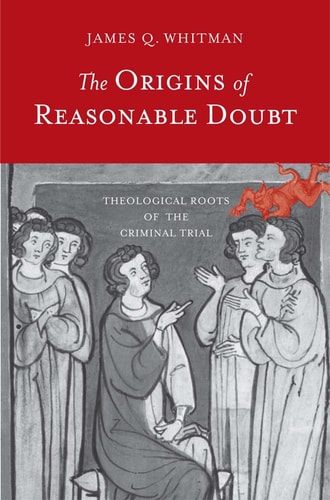
The Origins of Reasonable Doubt: Theological Roots of the Criminal Trial
0
0
As an Amazon Associate and affiliate partner, Menrva Books earns from qualifying purchases. Learn more
Author Description
To be convicted of a crime in the United States, a person must be proven guilty "beyond a reasonable doubt." But what is reasonable doubt? Even sophisticated legal experts find this fundamental doctrine difficult to explain. In this accessible book, James Q. Whitman digs deep into the history of the law and discovers that we have lost sight of the original purpose of "reasonable doubt." It was not originally a legal rule at all, he shows, but a theological one. The rule as we understand it today is intended to protect the accused. But Whitman traces its history back through centuries of Christian theology and common-law history to reveal that the original concern was to protect the souls of jurors. In Christian tradition, a person who experienced doubt yet convicted an innocent defendant was guilty of a mortal sin. Jurors fearful for their own souls were reassured that they were safe, as long as their doubts were not "reasonable." Today, the old rule of reasonable doubt survives, but it has been turned to different purposes. The result is confusion for jurors, and a serious moral challenge for our system of justice.
Menrva's Summary
THE THESIS
This book investigates the theological origins of the legal doctrine of "reasonable doubt" in the American criminal justice system. James Q. Whitman, a legal scholar, explores how the concept of reasonable doubt, fundamental to modern convictions, was not originally a legal rule but a theological one rooted in Christian tradition. The book traces this doctrine's evolution from a means to protect jurors' souls from mortal sin to its current application, which Whitman argues leads to confusion and moral challenges within the justice system.
THE SCOPE MAP
- The historical development of the "reasonable doubt" standard in criminal trials.
- The theological underpinnings of doubt and conviction within Christian doctrine.
- The shift in purpose from protecting jurors' souls to protecting the accused.
- Analysis of the confusion and moral challenges arising from the modern interpretation of reasonable doubt.
- The author's argument for a re-evaluation of the doctrine's original intent.
THE AUTHORITY PERSPECTIVE
The book offers a novel perspective on a cornerstone of legal procedure, tracing its roots to religious concerns rather than purely legal ones. By examining centuries of Christian theology and common-law history, Whitman reveals how the original intent of reasonable doubt has been obscured. The work is likely to be of interest to legal scholars, historians, and those interested in the intersection of law and religion, prompting a reconsideration of fundamental legal principles.
Page Count:
276
Publication Date:
2016-02-23
Publisher:
Yale University Press
ISBN-10:
0300219903
ISBN-13:
9780300219906
History
Non-Fiction
Criminal Law
Theology
Legal History
Community Tags
Similar Books