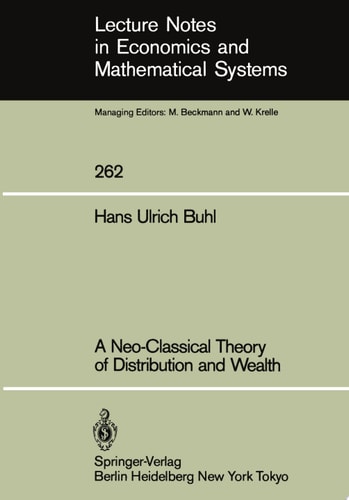
A Neo-Classical Theory of Distribution and Wealth
0
0
As an Amazon Associate and affiliate partner, Menrva Books earns from qualifying purchases. Learn more
Author Description
The distribution of capital and income in general and its re lation to wealth and economic growth in particular have attrac ted economists' interest for a long time already. Especially the, at least partially, conflicting nature of the two politi cal objectives, namely to obtain substantially large economic growth and a "just" income distribution at the same time, has caused the topic to become a subject of political discussions. As a result of these discussions, numerous models of workers' participation in the profits of growing economies have been developed. To a minor extent and with quite diverse success, some have been implemented in practice. It is far beyond the scope of this work to outline all these approaches from the past centuries and, in particular, the past decades. In economic theory many authors, for instance Kaldor [1955], Krelle [1968], [1983], Pasinetti [1962], Samuelson and Modigli ani [1966], to name but a few, have analyzed the long-term eco nomic implications of workers' saving and investment. While most of this extensive literature is highly interesting, it suffers from the fact that it does not explicitly consider either workers' or capitalists' objectives and thus neglects their impacts on economic growth. Thus, in the framework of a neo-classical model, these objectives and their impacts will be emphasized here.
Menrva's Summary
THE THESIS
This work investigates the long-term economic implications of workers' saving and investment within a neo-classical framework. The author addresses the persistent challenge of balancing economic growth with equitable income distribution, a topic of significant political and economic discussion. By focusing on the objectives of both workers and capitalists, the book aims to highlight their impacts on economic growth, an aspect often neglected in existing literature. The analysis is grounded in neo-classical economic theory, building upon previous models while emphasizing these crucial, often overlooked, agent-specific goals.
THE SCOPE MAP
- A neo-classical model analyzing capital and income distribution.
- Exploration of the relationship between wealth, economic growth, and income distribution.
- Discussion of political objectives related to economic growth and 'just' income distribution.
- Analysis of models for workers' participation in profits.
- Examination of the long-term economic implications of workers' saving and investment.
- Emphasis on the objectives and impacts of both workers and capitalists on economic growth.
THE AUTHORITY PERSPECTIVE
The book is positioned as a theoretical exploration within neo-classical economics, focusing on the intricate relationship between capital, income distribution, and economic growth. It aims to contribute to the ongoing debate by explicitly incorporating the objectives of workers and capitalists, which are often underemphasized in prior models. The work appears to be a specialized academic text, likely appealing to economists and researchers interested in theoretical frameworks for understanding wealth accumulation and distribution.
Page Count:
146
Publication Date:
2012-12-06
Publisher:
Springer Science & Business Media
ISBN-10:
3642465684
ISBN-13:
9783642465680
Economics
Non-Fiction
Economic Growth
Economic Theory
Capital
Community Tags
Other Editions(2)

Similar Books