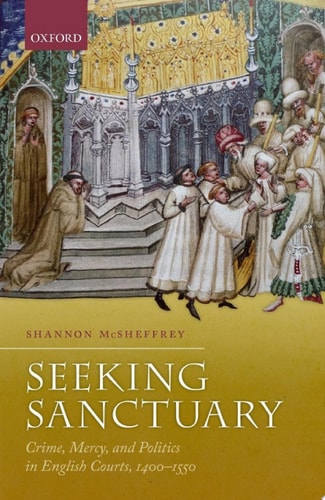
Seeking Sanctuary: Crime, Mercy, and Politics in English Courts, 1400-1550
0
0
As an Amazon Associate and affiliate partner, Menrva Books earns from qualifying purchases. Learn more
Author Description
Seeking Sanctuary' explores a curious aspect of premodern English law: the right of felons to shelter in a church or ecclesiastical precinct, remaining safe from arrest and trial in the king's courts. This is the first volume in more than a century to examine sanctuary in England in the fifteenth and sixteenth centuries. Looking anew at this subject challenges the prevailing assumptions in the scholarship that this 'medieval' practice had become outmoded and little-used by the fifteenth and sixteenth centuries. Although for decades after 1400 sanctuary-seeking was indeed fairly rare, the evidence in the legal records shows the numbers of felons seeing refuge in churches began to climb again in the late fifteenth century and reached its peak in the period between 1525 and 1535. Sanctuary was not so much a medieval practice accidentally surviving into the early modern era, as it was an organism that had continued to evolve and adapt to new environments and indeed flourished in its adapted state. Sanctuary suited the early Tudor regime: it intersected with rapidly developing ideas about jurisdiction and provided a means of mitigating the harsh capital penalties of the English law of felony that was useful not only to felons but also to the crown and the political elite. Sanctuary's resurgence after 1480 means we need to rethink how sanctuary worked, and to reconsider more broadly the intersections of culture, law, politics, and religion in the years between 1400 and 1550.
Menrva's Summary
THE THESIS
This book investigates the evolution and political utility of the legal right of sanctuary in England between 1400 and 1550, challenging the assumption that the practice was a dying medieval relic. Shannon McSheffrey, a historian specializing in late medieval and early modern England, utilizes extensive legal records and court archives to demonstrate that sanctuary-seeking actually experienced a significant resurgence during the early Tudor period. She argues that the practice functioned as a flexible mechanism for mitigating the harsh capital penalties of English felony law, serving the interests of both the crown and the political elite.
THE SCOPE MAP
What You Will Find
- Analysis of legal records concerning sanctuary-seeking from 1400 to 1550.
- Examination of the intersection between ecclesiastical immunity and royal jurisdiction.
- Case studies illustrating the practical application of sanctuary during the Tudor era.
Scope Limits
- The study focuses specifically on England and does not provide a comparative analysis of sanctuary practices in other European jurisdictions.
- The research does not cover the post-1550 period when the practice was largely abolished.
THE AUTHORITY PERSPECTIVE
Scholars recognize this work as a significant revisionist study that corrects long-standing misconceptions regarding the decline of sanctuary in the late Middle Ages. Readers frequently note the academic density of the prose, which provides a rigorous examination of legal and political history for specialists in the field.
Page Count:
0
Publication Date:
1900-01-01
Publisher:
Oxford University Press
ISBN-10:
0191839361
ISBN-13:
9780191839368
History
History - Modern
Legal History
Criminology
English History