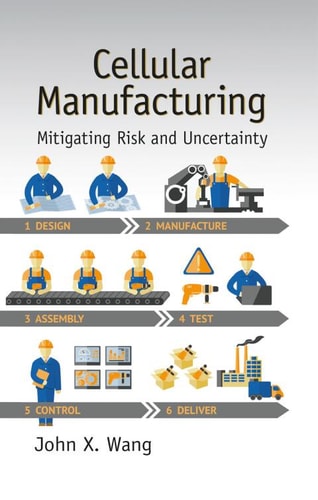
Cellular Manufacturing
0
0
As an Amazon Associate and affiliate partner, Menrva Books earns from qualifying purchases. Learn more
Author Description
In today’s business world, competitiveness defines the industrial leading edge. Organizations and businesses of all sizes are adopting Lean manufacturing practices to increase efficiency and address worries about their bottom lines. In a detailed review of this staple of Lean manufacturing, Cellular Manufacturing: Mitigating Risk and Uncertainty outlines how cellular manufacturing can do just that. It demonstrates how this approach can help you and your teams build a variety of products with as little waste as possible. The book begins by presenting a survey of the current state of existing methods that can best be used in the handling of the bottleneck machines and parts problem, which results from the cellular manufacturing system design. It then explores how decision making under risk is used to help the designer select the best cell arrangement in case of probabilistic production volume and maximize the profit imposed by resource capacity constraints. The author then presents a method for the system design of a manufacturing cell that aims for profit maximization over a certain period of time. He also discusses robust design, illustrated with a real application. Put simply, cellular manufacturing integrates machinery and a small team of staff, directed by a team leader, so all the work on a product or part can be accomplished in the same cell eliminating resources that do not add value to the product. A concise yet unique reference, this book incorporates decision making under risk into cellular manufacturing. The text makes the link that ties cellular manufacturing to the bottom line. It helps you recognize savings opportunities from elimination of downtime between operations, decreased material handling costs, decreased work-in-progress inventory and associated costs, reduced opportunity for handling errors, decreased downtime spent waiting for supplies or materials, and reduced losses from defective or obsolete products.
Menrva's Summary
THE THESIS
This book investigates how cellular manufacturing can mitigate risk and uncertainty to maximize profit in industrial settings. The author, John X. Wang, presents a detailed review of this Lean manufacturing practice, demonstrating its potential to reduce waste and increase efficiency. The book begins by surveying current methods for handling bottleneck machines and parts, then explores decision-making under risk for optimal cell arrangement given probabilistic production volumes. It culminates in a method for designing manufacturing cells to maximize profit over time, supported by a real-world application and discussion of robust design.
THE SCOPE MAP
- A survey of current methods for handling bottleneck machines and parts in cellular manufacturing.
- An exploration of decision-making under risk for selecting the best cell arrangement.
- A method for system design of a manufacturing cell aimed at profit maximization.
- Discussion of robust design principles with a real application.
- Analysis of how cellular manufacturing reduces waste, material handling costs, and inventory.
- Identification of savings opportunities through elimination of downtime and reduced errors.
THE AUTHORITY PERSPECTIVE
The book is presented as a concise reference for implementing cellular manufacturing, emphasizing its role in mitigating risk and uncertainty to improve profitability. It aims to guide organizations in building products with minimal waste by integrating machinery and staff into efficient cells. The text highlights the direct link between cellular manufacturing practices and tangible financial benefits, such as reduced inventory, lower handling costs, and fewer errors. It is positioned as a practical tool for recognizing and capitalizing on savings opportunities within industrial operations.
Page Count:
1152
Publication Date:
2015-01-14
Publisher:
Taylor & Francis
ISBN-10:
1040061532
ISBN-13:
9781040061534
Business
Non-Fiction
Business strategy
Community Tags
Other Editions(2)

Similar Books







Reader Comments
Share Your Thoughts
No comments yet. Be the first to share your thoughts!