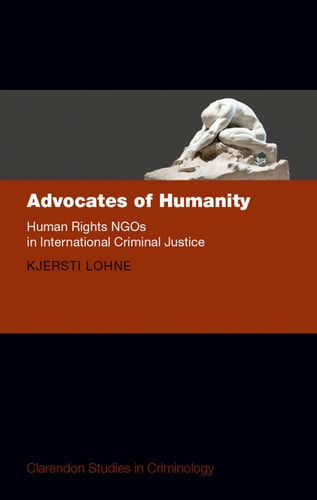
Advocates of Humanity: Human Rights NGOs in International Criminal Justice
0
0
As an Amazon Associate and affiliate partner, Menrva Books earns from qualifying purchases. Learn more
Author Description
Advocates of Humanity offers an analysis of international criminal justice from the perspective of sociology of punishment by exploring the role of human rights organizations in their mobilization for global justice through the International Criminal Court. Based on multi-sited ethnography, primarily in The Hague and Uganda, the author approaches the transnational networks of NGOs advocating for the ICC as an ethnographic object. A central objective is to explore how connections are made, and how forces and imaginations of global criminal justice travel. By analysing how international criminal justice is arranged spatially, and as such expresses social, political, and cultural relations of power, Advocates of Humanity shows how international criminal justice is situated in particular spaces, networks, and actors, and how they structure the imaginations of justice circulating in the field. From a sociology of punishment perspective, it compares the 'penal imaginations' of domestic and international criminal justice, and considers the particularly central role of victims as a universalized symbol of humanity for the legitimacy of international criminal justice. With clear global asymmetries emerging from the work, Advocates of Humanity provides descriptive as well as explanatory understandings of criminal punishment 'gone global', analysing its social causation while examining its cultural meanings, particularly as regards its role as an expression of 'the international' will to punish. To whom is it meaningful, and why?
Menrva's Summary
THE THESIS
How do human rights non-governmental organizations (NGOs) shape the mobilization, legitimacy, and spatial arrangement of international criminal justice within the framework of the International Criminal Court? Kjersti Lohne, a scholar in the sociology of punishment, utilizes a multi-sited ethnographic approach to examine the transnational networks advocating for global justice. By analyzing the movement of ideas and actors between sites such as The Hague and Uganda, the author argues that international criminal justice is not a neutral legal process but a socially constructed field defined by power relations and specific cultural imaginations. The work investigates how these organizations construct the victim as a universal symbol to justify the global expansion of penal practices.
THE SCOPE MAP
What You Will Find
- Ethnographic analysis of NGO networks operating within the International Criminal Court system
- Comparative framework between domestic and international penal imaginations
- Examination of spatial and political power dynamics in global justice
- Theoretical application of the sociology of punishment to international law
Scope Limits
- The study does not provide a comprehensive legal history of the International Criminal Court
- It does not focus on the technical procedural aspects of international trials
THE AUTHORITY PERSPECTIVE
Experts in sociology and international relations recognize this text as a significant contribution to the critical study of global penal institutions. Readers frequently note the academic density of the prose, which is best suited for researchers and students interested in the intersection of sociology, law, and human rights advocacy.
Page Count:
0
Publication Date:
2019-01-01
Publisher:
Oxford University Press
ISBN-10:
019185963X
ISBN-13:
9780191859632
International Law
Sociology
Human rights
Ethnography