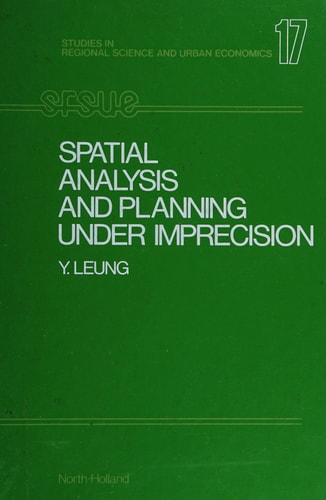
Spatial Analysis and Planning under Imprecision
0
0
As an Amazon Associate and affiliate partner, Menrva Books earns from qualifying purchases. Learn more
Author Description
The book deals with complexity, imprecision, human valuation, and uncertainty in spatial analysis and planning, providing a systematic exposure of a new philosophical and theoretical foundation for spatial analysis and planning under imprecision. Regional concepts and regionalization, spatial preference-utility-choice structures, spatial optimization with single and multiple objectives, dynamic spatial systems and their controls are analyzed in sequence.The analytical framework is based on fuzzy set theory. Basic concepts of fuzzy set theory are first discussed. Many numerical examples and empirical studies are provided to substantiate the theoretical arguments and empirical relevance of this approach.The book provides a more comprehensive perspective on uncertainty and a flexible framework for analysis in the real world, for problems such as commonly encountered spatial problems, urban and regional economic problems, and planning problems. Though the treatment is unconventional, it generally includes conventional analyses as special cases. Review T. John Kim..... highly informative and extremely valuable.Journal of Regional Science
Menrva's Summary
THE THESIS
This book establishes a new theoretical and philosophical foundation for spatial analysis and planning by addressing complexity, imprecision, human valuation, and uncertainty. It systematically explores regional concepts, spatial preference-utility-choice structures, and dynamic spatial systems, all analyzed through the lens of fuzzy set theory. The work provides a more comprehensive perspective on uncertainty and a flexible framework for real-world problems in spatial, urban, and regional economics and planning. Though unconventional, its treatment generally encompasses conventional analyses as special cases.
THE SCOPE MAP
- Application of fuzzy set theory to spatial analysis and planning.
- Analysis of regional concepts and regionalization.
- Exploration of spatial preference-utility-choice structures.
- Methods for spatial optimization with single and multiple objectives.
- Examination of dynamic spatial systems and their controls.
- Numerous numerical examples and empirical studies.
- A framework for addressing uncertainty in real-world spatial and economic problems.
THE AUTHORITY PERSPECTIVE
The book is described as highly informative and extremely valuable by T. John Kim in the Journal of Regional Science. The analytical framework, based on fuzzy set theory, offers a comprehensive perspective on uncertainty and a flexible approach to complex spatial and economic problems. Its treatment of conventional analyses as special cases suggests a robust and adaptable methodology. The inclusion of numerical examples and empirical studies further substantiates its theoretical arguments and practical relevance.
Page Count:
375
Publication Date:
1988-04-15
Publisher:
North Holland
ISBN-10:
044470390X
ISBN-13:
9780444703903
Economics
Science
Non-Fiction
urban planning
Data Analysis
Community Tags
Similar Books