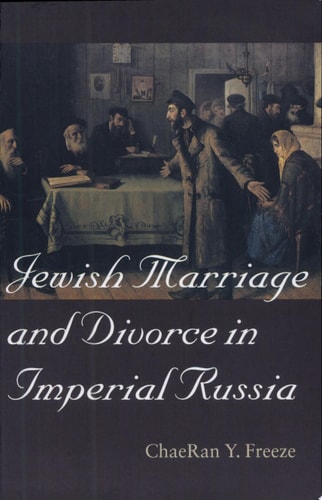
Jewish Marriage and Divorce in Imperial Russia
0
0
As an Amazon Associate and affiliate partner, Menrva Books earns from qualifying purchases. Learn more
Author Description
ChaeRan Freeze explores the impact of various forces on marriage and divorce among Jews in 19th-century Russia. Challenging romantic views of the Jewish family in the shtetl, she shows that divorce rates among Russian Jews in the first half of the century were astronomical compared to the non-Jewish population. Even more surprising is her conclusion that these divorce rates tended to drop later in the century, in contrast to the rising pattern among populations undergoing modernization. Freeze also studies the growing involvement of the Tsarist state. This occurred partly at the behest of Jewish women contesting patriarchy and parental power and partly because the government felt that Jewish families were in complete anarchy and in need of order and regulation. Extensive research in newly-declassified collections from twelve archives in Russia, Ukraine, and Lithuania enables Freeze to reconstruct Jewish patterns of marriage and divorce and to analyze the often conflicting interests of Jewish husbands and wives, rabbinic authorities, and the Russian state. Balancing archival resources with memoirs and printed sources in Hebrew, Yiddish, and Russian, she offers a tantalizing glimpse of the desires and travails of Jewish spouses, showing how individual life histories reflect the impact of modernization on Jewish matchmaking, gender relations, the "emancipation" of Jewish women, and the incursion of the Tsarist state into the lives of ordinary Jews.
Menrva's Summary
THE THESIS
The Tsarist state's increasing intervention in Jewish family life in 19th-century Russia is examined through the lens of marriage and divorce practices. ChaeRan Freeze challenges romanticized notions of the shtetl family by presenting evidence of exceptionally high divorce rates among Russian Jews in the early 19th century. She further argues that these rates declined later in the century, contrary to modernization trends elsewhere. The book details how both Jewish women seeking to contest patriarchal structures and the Russian government aiming to impose order on perceived Jewish familial anarchy fueled state involvement. Freeze's extensive archival research, combined with analysis of memoirs and printed sources in multiple languages, reconstructs these complex patterns and the conflicting interests of all parties involved.
THE SCOPE MAP
- Analysis of marriage and divorce patterns among Jews in 19th-century Russia.
- Examination of the impact of modernization on Jewish matchmaking and gender relations.
- Study of the role of Jewish women in contesting patriarchy and parental authority.
- Investigation into the Tsarist state's motivations for intervening in Jewish family law.
- Reconstruction of Jewish marriage and divorce patterns using archival collections from Russia, Ukraine, and Lithuania.
- Analysis of the interplay between Jewish husbands and wives, rabbinic authorities, and the Russian state.
- Exploration of the 'emancipation' of Jewish women and its effect on family structures.
- Use of memoirs and printed sources in Hebrew, Yiddish, and Russian alongside archival data.
THE AUTHORITY PERSPECTIVE
This scholarly work is recognized for its rigorous archival research and its challenge to conventional views of Jewish family life in the 19th century. Freeze's findings on divorce rates and their divergence from modernization trends are noted as particularly surprising. The book is appreciated for its detailed reconstruction of the complex dynamics between Jewish spouses, religious authorities, and the imperial state. It offers a nuanced perspective on how modernization and state intervention reshaped Jewish lives and gender relations.
Page Count:
399
Publication Date:
2002-01-01
Publisher:
UPNE
ISBN-10:
1584651601
ISBN-13:
9781584651604
Non-Fiction
History
Legal History
Jewish Studies
Social History
Family history
Community Tags
Similar Books