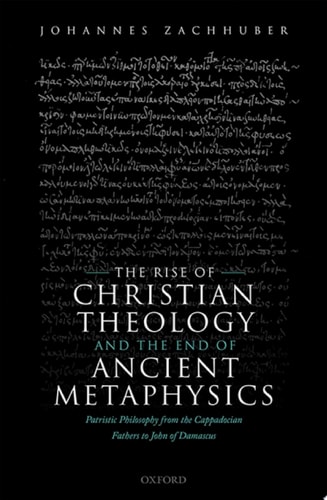
The Rise of Christian Theology and the End of Ancient Metaphysics: Patristic Philosophy from the Cappadocian Fathers to John of Damascus
0
0
As an Amazon Associate and affiliate partner, Menrva Books earns from qualifying purchases. Learn more
Author Description
It Has Rarely Been Recognized That The Christian Writers Of The First Millennium Pursued An Ambitious And Exciting Philosophical Project Alongside Their Engagement In The Doctrinal Controversies Of Their Age. The Rise Of Christian Theology And The End Of Ancient Metaphysics Offers, For The First Time, A Full Analysis Of This Patristic Philosophy. It Shows How It Took Its Distinctive Shape In The Late Fourth Century And Gives An Account Of Its Subsequent Development Until The Time Of John Of Damascus. The Book Falls Into Three Main Parts. The First Starts With An Analysis Of The Philosophical Project Underlying The Teaching Of The Cappadocian Fathers, Basil Of Caesarea, Gregory Of Nyssa And Gregory Of Nazianzus. This Philosophy, Arguably The First Distinctively Christian Theory Of Being, Soon Became Near-universally Shared In Eastern Christianity. Just A Few Decades After The Cappadocians, All Sides In The Early Christological Controversy Took Its Fundamental Tenets For Granted. Its Application To The Christological Problem Thus Appeared Inevitable. Yet It Created Substantial Conceptual Problems. Parts Two And Three Describe In Detail How These Problems Led To A Series Of Increasingly Radical Modifications Of The Cappadocian Philosophy. In Part Two, Zachhuber Explores The Miaphysite Opponents Of The Council Of Chalcedon, While In Part Three He Discusses The Defenders Of The Council From The Early Sixth To The Eighth Century. Through This Overview, The Book Reveals This Period As One Of Remarkable Philosophical Creativity, Fecundity, And Innovation.
Menrva's Summary
THE THESIS
This book investigates the emergence of a distinctively Christian theory of being within the first millennium and its subsequent transformation through the lens of Christological controversies. Johannes Zachhuber, a scholar of historical theology, examines how the philosophical framework established by the Cappadocian Fathers evolved to address the logical and conceptual challenges inherent in early Christian doctrine. By analyzing the shift from ancient metaphysical traditions to a new theological paradigm, the author argues that this era was defined by significant philosophical innovation rather than mere doctrinal repetition.
THE SCOPE MAP
What You Will Find
- An analysis of the philosophical project of Basil of Caesarea, Gregory of Nyssa, and Gregory of Nazianzus.
- A detailed examination of the Christological controversies and their impact on metaphysical thought.
- Comparative studies of Miaphysite and Chalcedonian thinkers, including Severus of Antioch and John Philoponus.
- A chronological progression from the late fourth century through the eighth century, concluding with John of Damascus.
Scope Limits
- The text does not provide a comprehensive history of all early Christian thought, focusing specifically on the development of metaphysical and ontological theories.
- It does not extensively cover Western Latin theological developments, maintaining a primary focus on Eastern Christian philosophy.
THE AUTHORITY PERSPECTIVE
Scholars and historians of late antiquity frequently highlight this work as a rigorous re-evaluation of the intellectual depth present in Patristic writings. Readers often note the academic density of the prose, which requires a foundational understanding of both classical philosophy and early Christian history to fully grasp the author's complex arguments.
Page Count:
0
Publication Date:
1900-01-01
Publisher:
Oxford University Press,
ISBN-10:
0191892378
ISBN-13:
9780191892370
History
Philosophy
Christianisme
Metaphysics
Christianity
Patristics
Theology