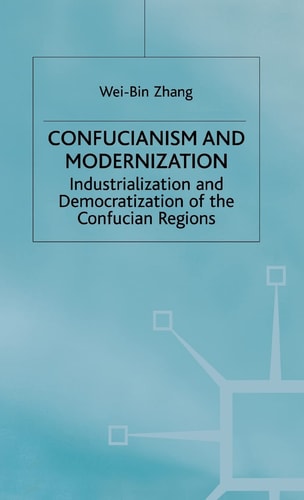
Confucianism and Modernisation: Industrialization and Democratization in East Asia
0
0
As an Amazon Associate and affiliate partner, Menrva Books earns from qualifying purchases. Learn more
Author Description
Wei-Bin Zhang offers an authoritative guide to the philosophy of Confucianism and its impact in the Confucian regions, covering mainland China, Taiwan, Hong Kong, Macao, Japan, South Korea, North Korea, Vietnam and Singapore. All, except Singapore, employed Confucianism as the state ideology before the West came to East Asia. The differences and similarities between the variety of Confucian schools are examined. The author concludes that the philosophical and ethical principles of Confucianism will assist in the industrialization and democratization of the region.
Menrva's Summary
THE THESIS
The book investigates the complex relationship between Confucianism and the processes of modernization, specifically industrialization and democratization, in East Asia. Wei-Bin Zhang, an authoritative guide in this field, examines the philosophy of Confucianism and its pervasive influence across various East Asian regions, including mainland China, Taiwan, Hong Kong, Macao, Japan, South Korea, North Korea, and Vietnam. The work scrutinizes the distinctions and commonalities among diverse Confucian schools of thought. Ultimately, Zhang posits that Confucianism's core philosophical and ethical tenets offer a foundational framework that can actively support the ongoing industrialization and democratization efforts within the region.
THE SCOPE MAP
- An examination of Confucianism as a state ideology in pre-Western East Asia.
- Comparative analysis of Confucian schools across different East Asian nations.
- Exploration of the philosophical and ethical principles of Confucianism.
- Argument for Confucianism's role in supporting industrialization.
- Argument for Confucianism's role in supporting democratization.
THE AUTHORITY PERSPECTIVE
The book is regarded as an authoritative guide to Confucianism's impact on modernization in East Asia. It provides a comprehensive overview of the philosophy and its regional variations, making a clear case for its continued relevance. The author's analysis connects historical ideology with contemporary developmental goals, offering a nuanced perspective on the region's socio-political trajectory.
Page Count:
229
Publication Date:
1999-09-10
Publisher:
Palgrave Macmillan UK
ISBN-10:
0312224117
ISBN-13:
9780312224110
History
Non-Fiction
Philosophy
Politics
Asian Studies
Community Tags
Similar Books