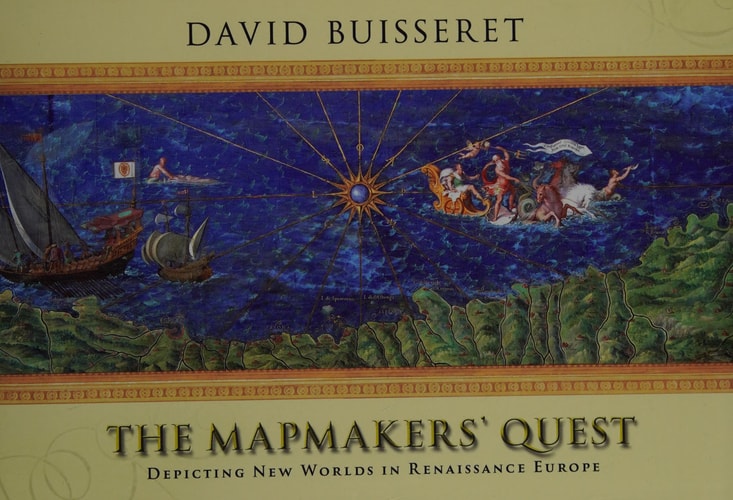
The Mapmakers' Quest: Depicting New Worlds in Renaissance Europe
0
0
As an Amazon Associate and affiliate partner, Menrva Books earns from qualifying purchases. Learn more
Author Description
In 1400 Europe lagged far behind much of the world in its understanding of the use of maps. And yet, by 1600 the Europeans had come to use maps for a huge variety of tasks, and were far ahead of the rest of the world in their appreciation of the power and use of cartography. The Mapmakers' Quest illuminates the forces behind this development--not only to tease out the strands of thought and practice which led to the use of maps, but also to assess the ways in which such use affected European societies and economies.David Buisseret is one of the most eminent historians of cartography, and in this striking volume he offers a fresh and compelling approach to the cultural history of early modern Europe, revealing how the development of maps shaped and was shaped by larger movements. Taking as a starting point the question of why there were so few maps in Europe in 1400 and so many by 1650, the book explores the reasons for this and its implications for European history. It examines how mapping and military technology advanced in tandem, how modern states' territories were mapped and borders drawn up, the role of maps in shaping the urban environment, and cartography's links to the new sciences.
Menrva's Summary
THE THESIS
This work investigates the rapid transformation of European cartography between 1400 and 1600, seeking to explain why map usage shifted from a marginal practice to a central component of societal and economic life. David Buisseret, a recognized authority in the history of cartography, utilizes a cultural history framework to analyze the intersection of mapmaking with military, scientific, and political developments. He argues that the proliferation of maps was not merely a technical achievement but a fundamental driver of the modern European state and its administrative capabilities.
THE SCOPE MAP
What You Will Find
- Analysis of the transition from medieval map scarcity to early modern cartographic saturation
- Examination of the relationship between military technology and mapping techniques
- Discussion of the role of cartography in urban planning and border definition
- Exploration of the links between mapmaking and the emergence of new scientific methodologies
Scope Limits
- The text focuses primarily on the European context and does not provide a global comparative analysis of non-European cartographic traditions
- The study does not offer a technical manual for historical map production or restoration
THE AUTHORITY PERSPECTIVE
Scholars and historians of cartography regard this volume as a significant contribution to understanding the cultural impact of early modern mapping. Readers frequently note the clarity of the prose, which makes complex historical shifts accessible to both academic and general audiences interested in the history of science.
Page Count:
256
Publication Date:
2003-07-24
Publisher:
Oxford University Press
ISBN-10:
019210053X
ISBN-13:
9780192100535
History
Cartography history
Engineering
Cartography
Cultural History
Science and Technology
Kindle eBooks
Kindle Store
Categories
Renaissance
Europe
European History
Community Tags
Similar Books