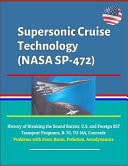
Supersonic Cruise Technology (NASA SP-472)
0
0
As an Amazon Associate and affiliate partner, Menrva Books earns from qualifying purchases. Learn more
Author Description
This NASA document provides a historic perspective of supersonic cruise technology, beginning with the early NACA supersonic research and including efforts during the B-70 and SST phase. It also records technological progress made in the NASA SCR and VCE programs. Since every research result could not be detailed here, only the most critical technology issues and research findings are presented.NASA and its predecessor, the National Advisory Committee for Aeronautics (NACA), have participated since 1920 in efforts to develop the technology required for supersonic cruise flight. Preliminary work concentrated on developing rudimentary test facilities and methods that would permit the investigation of supersonic problems. This was accompanied by research for defining aircraft and propulsion concepts for flight at speeds greater than the speed of sound. These early investigations contributed to the development of the joint U.S. Air Force/Navy/Bell XS-1 airplane that was piloted on the first successful supersonic flight by Air Force Capt. Charles E. "Chuck" Yeager in 1947. Between 1956 and 1971, a strong research effort supported the USAF supersonic B-70 and commercial supersonic transport concepts. After neither of these programs resulted in a production aircraft because of technical and political problems, NASA was given the responsibility of establishing the technology base for a viable supersonic cruise airplane. This latter effort, known as the NASA Supersonic Cruise Research (SCR) program, was conducted from 1971 to 1981. The NASA Variable Cycle Engine (VCE) program, a propulsion offshoot of SCR, was conducted from 1976 to 1981.1 Introduction * 2 Setting The Stage For Supersonic Cruise Technology * The Sound Barrier * The First Supersonic Cruise Aircraft * The Next Logical Step * After the U.S. Supersonic Transport Program * 3 NACA Preliminary Supersonic Cruise Technology (?-1956) * Mounting an Attack on the Sound Barrier * Breaking the Sound Barrier * 4 NACA/NASA
Menrva's Summary
THE THESIS
This document chronicles the historical development and technological challenges of supersonic cruise flight.
The book traces NASA's and its predecessor NACA's involvement in supersonic research from its early days, focusing on the development of necessary test facilities and methods. It details the technological progress made during critical programs like the B-70, the commercial Supersonic Transport (SST) concepts, and NASA's subsequent Supersonic Cruise Research (SCR) and Variable Cycle Engine (VCE) programs, highlighting the most critical issues and findings that paved the way for supersonic flight.
THE SCOPE MAP
- Early NACA supersonic research and rudimentary test facility development.
- The technological advancements leading to the first supersonic flight in the XS-1.
- Research supporting the USAF B-70 and commercial SST concepts.
- NASA's Supersonic Cruise Research (SCR) program (1971-1981).
- The NASA Variable Cycle Engine (VCE) program (1976-1981).
- Key technological issues and research findings in supersonic cruise technology.
- Historical context of breaking the sound barrier and early supersonic aircraft.
THE AUTHORITY PERSPECTIVE
This historical document from NASA provides a technical overview of supersonic cruise technology, detailing the progression of research and development from early NACA efforts through the B-70 and SST programs, and into NASA's dedicated SCR and VCE initiatives. It focuses on presenting critical technological issues and findings rather than exhaustive detail, offering insight into the challenges of supersonic flight. The content is presented as a historical record of scientific and engineering progress in aviation.
Page Count:
140
Publication Date:
2019-07-03
Publisher:
Amazon Digital Services LLC - KDP Print US
ISBN-10:
1077952090
ISBN-13:
9781077952096
Non-Fiction
History
Science & Technology
Aviation History
Aerodynamics
Technology
Engineering
Community Tags
Similar Books





Reader Comments
Share Your Thoughts
No comments yet. Be the first to share your thoughts!