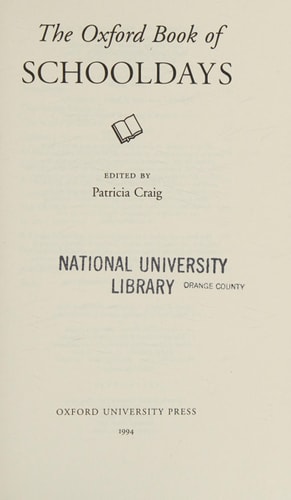
The Oxford Book of Schooldays
0
0
As an Amazon Associate and affiliate partner, Menrva Books earns from qualifying purchases. Learn more
Author Description
'School', wrote Henry Green, 'is no odder than the world outside, only more concentrated.' It is also an experience that everyone has to undergo, and many people have left accounts of their schooldays inspired either by repugnance or regret. The old school, whether you compare it to a Fascist state (as W.H. Auden famously did), a hothouse, a prison, or a place of lost content, remains with you for the rest of your life. Drawing on fiction, memoirs, autobiography, poetry, and letters Patricia Craig presents an enthralling selection of attitudes to schools and schooling. All manner of institutions are described, from village schools to state comprehensives, charity schools, public schools, private schools and grammar schools, with some (usually) fond reminiscences of primary schools for good measure. But the emphasis is on individual experience - on the playing field, in the classroom, making friends and enemies, encountering inspiring or eccentric schoolmasters. Pupils and teachers have their say, Miss Jean Brodie alongside Dr Arnold, Winston Churchill rubbing shoulders with Nicholas Nickleby. Through it all run the anarchic exploits of the heroes and heroines of the school story - Billy Bunter and the Greyfriars mob, Stalky and Co., William Brown, Tom Brown, and the creations of T.B. Reed and Angela Brazil. Ranging from the sixteenth century to the present day, and focusing on Great Britain and Northern Ireland, this anthology sheds incidental light on attitudes to children, educational systems, and the divisions of British society. It will strike a chord with every pupil, past or present, in revealing the glories and defects of British education.
Menrva's Summary
THE THESIS
This anthology investigates the multifaceted, often contradictory nature of the British educational experience through the lens of literature and personal testimony. Patricia H. Craig, an experienced editor and literary critic, compiles a diverse array of primary sources ranging from the sixteenth century to the modern era. By juxtaposing fictional accounts with historical memoirs and letters, the book argues that the school environment serves as a concentrated microcosm of broader societal structures and class divisions.
THE SCOPE MAP
What You Will Find
- A chronological collection of excerpts from fiction, memoirs, poetry, and correspondence.
- Diverse institutional representations, including public schools, charity schools, and state comprehensives.
- Perspectives from both students and educators across several centuries of British history.
Scope Limits
- The collection is geographically restricted to Great Britain and Northern Ireland.
- It does not provide a systematic pedagogical analysis of educational policy, focusing instead on individual narrative experience.
THE AUTHORITY PERSPECTIVE
Critics often note the breadth of the selection, which successfully balances canonical literary figures with lesser-known autobiographical accounts. The text is frequently cited as a valuable resource for those interested in the cultural history of British schooling and the evolution of childhood representation.
Page Count:
447
Publication Date:
1994-01-01
Publisher:
Oxford Univ Pr
ISBN-10:
0192142038
ISBN-13:
9780192142030
Memoir
Education
Literary Criticism
Schools
Social History
Anthology
English literature
British History
Community Tags
Similar Books