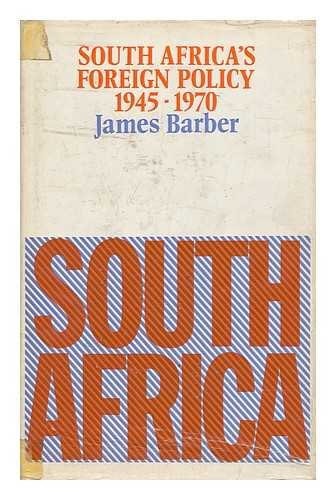
South Africa's Foreign Policy, 1945-1970
0
0
As an Amazon Associate and affiliate partner, Menrva Books earns from qualifying purchases. Learn more
Author Description
This book was originally published in 1990, as part of the Cambridge Studies in International Relations series, a joint initiative of Cambridge University Press and the British International Studies Association (BISA). In a far-reaching and fascinating study of foreign policy in South Africa, Barber and Barratt begin by looking at the post-war challenges faced by the government of South Africa, and the effect that the establishment of apartheid also had on foreign policy. Their study then goes on to explore the effects that Sharpeville, and the repercussions of various periods of success and upheaval, had on South African international relations up until the late 1980s. This exceptionally thorough study of South African foreign policy and the factors influencing its formation will be of interest to scholars of South Africa in particular, and international relations and policy making in general.
Menrva's Summary
THE THESIS
This work investigates how the South African government navigated the complex intersection of post-war international pressures and the internal implementation of apartheid between 1945 and the late 1980s. James P. Barber and John Barratt utilize their expertise in international relations to analyze the shifting diplomatic landscape of the region. The authors argue that domestic racial policies were the primary driver of South Africa's increasing isolation and the subsequent transformation of its foreign policy objectives over several decades.
THE SCOPE MAP
What You Will Find
- Analysis of post-World War II diplomatic challenges for the South African state.
- Examination of the impact of the Sharpeville massacre on international relations.
- Longitudinal study of policy shifts from 1945 through the late 1980s.
- Evaluation of the interplay between domestic apartheid legislation and external statecraft.
Scope Limits
- The text focuses primarily on formal government policy rather than grassroots social movements.
- It does not provide an exhaustive account of post-1990 democratic transition policies.
THE AUTHORITY PERSPECTIVE
Scholars frequently cite this work as a foundational text for understanding the diplomatic isolation of South Africa during the twentieth century. The prose is noted for its academic rigor and its ability to synthesize complex geopolitical shifts into a coherent historical framework.
Page Count:
325
Publication Date:
1973-01-01
Publisher:
Oxford University Press
ISBN-10:
0192156519
ISBN-13:
9780192156518
History
African history
International relations
Apartheid
Foreign Policy
Community Tags
Similar Books