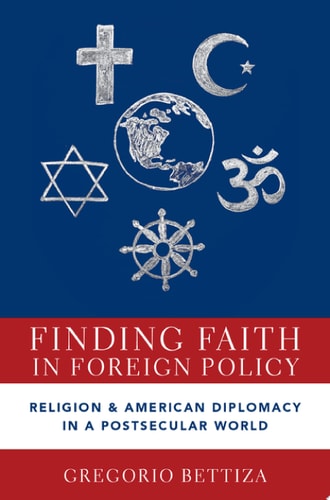
Finding Faith in Foreign Policy: Religion and American Diplomacy in a Postsecular World
0
0
As an Amazon Associate and affiliate partner, Menrva Books earns from qualifying purchases. Learn more
Author Description
Since the end of the Cold War, religion has become an ever more explicit and systematic focus of US foreign policy across multiple domains. US foreign policymakers, for instance, have been increasingly tasked with monitoring religious freedom and promoting it globally, delivering humanitarian and development aid abroad by drawing on faith-based organizations, fighting global terrorism by seeking to reform Muslim societies and Islamic theologies, and advancing American interests and values more broadly worldwide by engaging with religious actors and dynamics. Simply put, religion has become a major subject and object of American foreign policy in ways that were unimaginable just a few decades ago.In Finding Faith in Foreign Policy, Gregorio Bettiza explains the causes and consequences of this shift by developing an original theoretical framework and drawing upon extensive empirical research and interviews. He argues that American foreign policy and religious forces have become ever more inextricably entangled in an age witnessing a global resurgence of religion and the emergence of a postsecular world society. He further shows how the boundaries between faith and state have been redefined through processes of desecularization in the context of American foreign policy, leading the most powerful state in the international system to intervene and reshape in increasingly sustained ways sacred and secular landscapes around the globe.Drawing from a rich evidentiary base spanning twenty-five years, Finding Faith in Foreign Policy details how a wave of religious enthusiasm has transformed not just American foreign policy, but the entire international system.
Menrva's Summary
THE THESIS
This book investigates how and why religion has transitioned from a peripheral concern to a central, systematic focus of United States foreign policy in the post-Cold War era. Gregorio Bettiza, a scholar of international relations, utilizes a theoretical framework centered on the concept of the postsecular world to analyze this shift. He argues that the entanglement of American statecraft with religious actors and dynamics represents a significant process of desecularization that fundamentally alters how the United States engages with global sacred and secular landscapes.
THE SCOPE MAP
What You Will Find
- An analysis of the integration of religious freedom monitoring into diplomatic agendas.
- Examination of the role of faith-based organizations in humanitarian and development aid.
- A study of counter-terrorism strategies focused on the reform of Islamic theologies.
- A theoretical framework defining the postsecular international system.
Scope Limits
- The analysis focuses primarily on the American state apparatus and its specific diplomatic interventions.
- The text does not provide a comprehensive history of global religious movements outside of their interaction with US policy.
THE AUTHORITY PERSPECTIVE
Experts recognize this work as a significant contribution to the study of religion in international relations, noting its rigorous empirical foundation. Readers frequently highlight the clarity of the author's theoretical framework when navigating the complex intersection of secular governance and religious influence.
Page Count:
336
Publication Date:
2019-07-02
Publisher:
Oxford University Press
ISBN-10:
0190949465
ISBN-13:
9780190949464
History
United States
International relations
Foreign Policy
Religion and Politics
Sociology
Community Tags
Similar Books