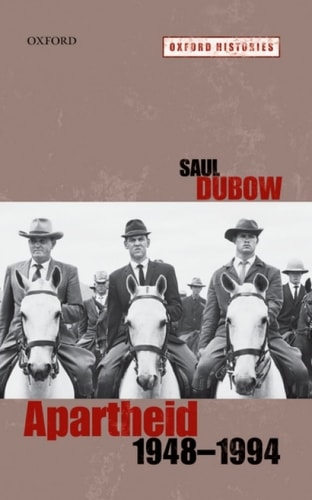
Apartheid, 1948-1994
0
0
As an Amazon Associate and affiliate partner, Menrva Books earns from qualifying purchases. Learn more
Author Description
This new study offers a fresh interpretation of apartheid South Africa. Emerging out of the author's long-standing interests in the history of racial segregation, and drawing on a great deal of new scholarship, archival collections, and personal memoirs, he situates apartheid in global as well as local contexts. The overall conception of Apartheid, 1948-1994 is to integrate studies of resistance with the analysis of power, paying attention to the importance of ideas, institutions, and culture. Saul Dubow refamiliarises and defamiliarise apartheid so as to approach South Africa's white supremacist past from unlikely perspectives. He asks not only why apartheid was defeated, but how it survived so long. He neither presumes the rise of apartheid nor its demise. This synoptic reinterpretation is designed to introduce students to apartheid and to generate new questions for experts in the field.
Menrva's Summary
THE THESIS
How did the system of apartheid in South Africa maintain its structural integrity for nearly half a century while simultaneously containing the seeds of its own eventual collapse? Saul Dubow, a recognized scholar in the history of racial segregation, synthesizes decades of archival research, personal memoirs, and contemporary scholarship to re-examine the apartheid era. He moves beyond traditional narratives of inevitable rise and fall, instead analyzing the interplay between institutional power, cultural ideology, and organized resistance. The work provides a comprehensive framework for understanding the mechanisms that allowed white supremacy to persist within both local and global contexts.
THE SCOPE MAP
What You Will Find
- Historical analysis of the South African political landscape from 1948 to 1994.
- Integration of resistance movements with the study of state-sanctioned power structures.
- Examination of the role of ideas, institutions, and cultural norms in sustaining segregation.
- Synthesis of archival collections and personal accounts.
Scope Limits
- The text focuses primarily on the political and structural history of the apartheid state rather than a comprehensive military history of the liberation struggle.
- It does not provide an exhaustive day-to-day chronology of every event during the period.
THE AUTHORITY PERSPECTIVE
Experts and academics frequently cite this work as a sophisticated, nuanced reinterpretation that successfully avoids the pitfalls of teleological historical analysis. Students and researchers value the text for its ability to balance high-level synthesis with specific, challenging questions that push the boundaries of current historiography.
Page Count:
384
Publication Date:
2014-01-01
Publisher:
OUP Oxford
ISBN-10:
0191009504
ISBN-13:
9780191009501
History
Sociology
South Africa
African history
Apartheid
Community Tags
Other Editions(3)


Similar Books