Memoir of a Thinking Radish
0
0
As an Amazon Associate and affiliate partner, Menrva Books earns from qualifying purchases. Learn more
Author Description
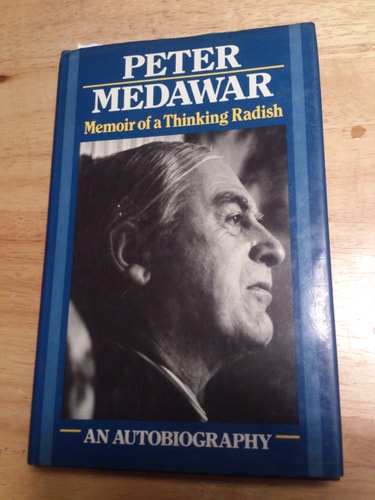
"He's tart, tough-minded, terribly British...an imposing grand master of aphorism, argument and lightning-bolt one-liners." So Newsweek writer wrote of Sir Peter Medawar, the renowned British immunologist. "The most accomplished writer of popular-science essays," declared the Philadelphia Inquirer. Now this Nobel Prize-winning scientist and highly acclaimed author of Pluto's Republic, Aristotle to Zoos, and many other books has written a fascinating account of his own life.The image of man as a cross between Pascal's "thinking reed" and Falstaff's "forked radish," expressed in the title of Sir Peter's autobiography, stems from his humble desire "not to claim for myself as an author any distinction more extravagant than membership of the human race." But it is an exceptional life that unfolds in the pages of this incisive and witty memoir. Sir Peter describes his early years in Rio de Janiero, "the rude and barbaric life of Marlborough," Oxford in 1930s, his illnesses and recovery, and the rewards and frustrations of work in a wide variety of academic institutions around the world. Rich anecdotes abound--his early school days and family life, his musical education, his wife Jean and their family, his frequent visits to America, and much more. A sheer delight to read, this highly personal account illuminates the life of one of the most engaging and impressive men of out time.About the Author:Sir Peter Medawar won the 1960 Nobel Prize for Medicine. He is a Fellow of the British Academy and author of several volumes of scientific essays.The Noble Prizewinner reminisces about his dual career in the worlds of science and letters
Menrva's Summary
THE THESIS
How does a Nobel Prize-winning scientist reconcile the intellectual rigor of biological research with the humanistic pursuit of literature and personal reflection? Sir Peter Medawar, a distinguished immunologist and essayist, utilizes his own life trajectory to examine the intersection of scientific discovery and the broader human experience. He presents his life not as a grand narrative of achievement, but as a series of intellectual and personal encounters, framing his identity through the lens of both scientific inquiry and philosophical curiosity.
THE SCOPE MAP
What You Will Find
- Chronological account of Medawar's upbringing in Rio de Janeiro and his education at Oxford.
- Reflections on the institutional culture of 20th-century academia and scientific research.
- Personal anecdotes regarding his family life, marriage to Jean, and his experiences in international scientific circles.
Scope Limits
- The text does not provide a comprehensive technical manual for his immunological breakthroughs.
- It avoids exhaustive administrative detail regarding his various academic appointments.
THE AUTHORITY PERSPECTIVE
Critics and readers frequently praise the prose for its wit, clarity, and the author's ability to maintain a self-deprecating tone despite his significant professional stature. Experts often cite this work as a model for how scientists can effectively communicate their personal history alongside their intellectual contributions.
Page Count:
219
Publication Date:
1986-06-12
Publisher:
Oxford University Press
ISBN-10:
0192177370
ISBN-13:
9780192177377
Biography
Autobiography
Non-Fiction
Memoir
Science
Immunology
Scientists
Community Tags
Similar Books