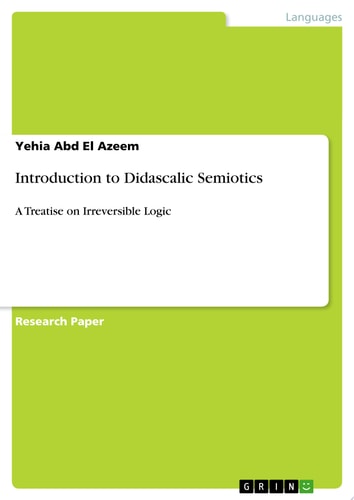
Introduction to Didascalic Semiotics: A Treatise on Irreversible Logic
0
0
As an Amazon Associate and affiliate partner, Menrva Books earns from qualifying purchases. Learn more
Author Description
By the virtue of an experimental non-fictive interjection in didascalia, basically as a meta-textual liberation from narrative Drama (scripts read rather than performed) and which is in due to be tackled in this essay on a verge of criticism; rhetorical inference, that which is intrinsic within the ideal scarcity of dialogical perlocutionary acts (since stage directions are mostly descriptive) could be claimed - under formal theoretical parameters - to propose one of independent chronologies or otherwise a differed diegetic timing against the original immediacy of authorship, if we could estrange the absent author from ontological audience. In other words, if didascalia are mostly known as to be structurally reflexive in correspondence to the linearity of time and actions (fictitious variables) whether to performers on stage, or to readers off-stage-through a medium coder of signifiers (author) would the authorial upmost reference retain the same mode of diegetic liberation when dualized; according to which signature (before dialogue and thus before reference) and omniscience (off dialogue and hence unreliable) manifest a ‘space’ of didascalic autology*? On the alert of a transitional stage-direction thus from the fiction of narrative didascalia to a non-fiction of its meta-textuality, discrepancies appertaining the metaphoricity of its dialogical rhetoric are due to be rehearsed in between semiotic topographies, after which the non-dialogic rhetoric could be timed. Since the meta-textual metaphorical recognition of dramatis personae in modern drama is seemingly subjective to the omniscient rhetorical method of narration by virtue of unreliable representational comparability of signifiers (between what readers polarize by the prelocutionary force of dramatis personae against the descriptive extended allegory of
Menrva's Summary
THE THESIS
This treatise investigates the potential for stage directions (didascalia) to function as an independent narrative chronology or a distinct diegetic timing, separate from the original authorial intent. The author, Yehia Abd El Azeem, a postgraduate researcher at the University of Salford, explores how the inherent descriptive nature of stage directions, often limited in dialogue, can create a meta-textual space. This space, termed 'didascalic autology,' is examined through the lens of rhetorical inference and semiotic topographies, questioning whether the authorial reference retains its diegetic liberation when dualized into pre-dialogue signatures and post-dialogue omniscience. The work posits a transition from the fictional narrative of didascalia to the non-fiction of its meta-textuality, analyzing the non-dialogic rhetoric within this framework.
THE SCOPE MAP
- Analysis of didascalia as a meta-textual element distinct from narrative drama.
- Exploration of rhetorical inference within the scarcity of dialogical perlocutionary acts in scripts.
- Theoretical parameters for didascalia proposing independent chronologies or differed diegetic timing.
- Examination of the absent author's relationship to the ontological audience.
- The concept of 'didascalic autology' and its manifestation through authorial signature and omniscience.
- Transition from the fiction of narrative didascalia to the non-fiction of its meta-textuality.
- Rehearsal of discrepancies in the metaphoricity of dialogical rhetoric within semiotic topographies.
- Timing of non-dialogic rhetoric in relation to dramatic texts.
THE AUTHORITY PERSPECTIVE
This academic paper, presented as a postgraduate research effort from the University of Salford, delves into complex theoretical concepts within linguistics and semiotics. The abstract suggests a dense, analytical approach to the study of dramatic texts, focusing on the often-overlooked function of stage directions. The work appears to engage with literary theory and rhetorical analysis, aiming to establish a novel framework for understanding the temporal and narrative potential of didascalia. Its reception would likely be within academic circles specializing in speech science, linguistics, and theatre studies.
Page Count:
62
Publication Date:
2014-10-20
Publisher:
GRIN Verlag
ISBN-10:
3656817936
ISBN-13:
9783656817932
Literary Fiction
Non-Fiction
Semiotics
Speech Science
Rhetoric
Literary theory
Linguistics
Community Tags
Other Editions(2)
Similar Books

Reader Comments
Share Your Thoughts
No comments yet. Be the first to share your thoughts!