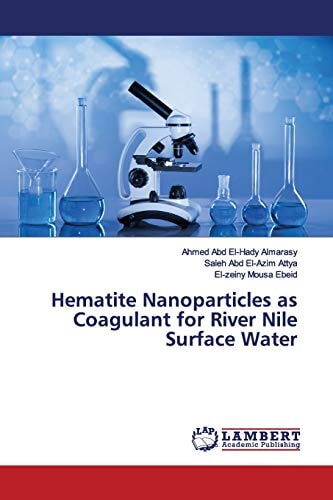
Hematite Nanoparticles as Coagulant for River Nile Surface Water
0
0
As an Amazon Associate and affiliate partner, Menrva Books earns from qualifying purchases. Learn more
Author Description
Drinking water in Egypt is provided by the Nile river. Aluminum sulfate are widely used as coagulants in the drinking water treatment processes in Egypt. Residual aluminum may cause several environmental consequences. Hematite nanoparticles have been used as coagulant in water treatment to avoid residual aluminum problems. There is a comparison between hematite nanoparticles and alum in coagulation process for drinking water treatment. Raw water samples were collected from Nile river Rosetta branch at Basyoun city at the uptake site of Basyoun's drinking water company. Hematite nanoparticles satisfy many crucial requirements including non-toxicity, indefinite stability, low cost and ease of production. In this study, experiments were conducted on nanoparticle of hematite ability as coagulant for drinking water treatment. The results show that the highest turbidity removal by hematite nanoparticles of values up to (93.8)%.
Menrva's Summary
THE THESIS
This study investigates the efficacy of hematite nanoparticles as a sustainable alternative to aluminum sulfate for coagulating surface water from the Nile River. The research addresses the environmental concerns associated with residual aluminum from traditional coagulants, proposing hematite nanoparticles as a non-toxic, stable, and cost-effective solution. Experiments were conducted using raw water samples from the Nile River Rosetta branch to compare the coagulation performance of hematite nanoparticles against alum, focusing on turbidity removal.
THE SCOPE MAP
- Evaluation of hematite nanoparticles as a coagulant for drinking water treatment.
- Comparison of hematite nanoparticles' coagulation performance against traditional alum.
- Analysis of turbidity removal efficiency using hematite nanoparticles.
- Assessment of hematite nanoparticles' properties: non-toxicity, stability, cost, and ease of production.
- Experimental data on the highest turbidity removal achieved by hematite nanoparticles (up to 93.8%).
- Focus on surface water from the Nile River Rosetta branch.
THE AUTHORITY PERSPECTIVE
The research presents a focused investigation into an alternative water treatment method, highlighting the potential of hematite nanoparticles to mitigate environmental issues linked to conventional coagulants like aluminum sulfate. The study details experimental results demonstrating significant turbidity removal, suggesting a viable application for improving drinking water quality in regions reliant on the Nile River. The findings are presented within the context of Egypt's water supply challenges and the need for sustainable treatment solutions.
Page Count:
52
Publication Date:
2019-01-31
Publisher:
LAP LAMBERT Academic Publishing
ISBN-10:
6139446244
ISBN-13:
9786139446247
Non-Fiction
Science
Chemistry
Water Treatment
Nanotechnology
Community Tags
Similar Books