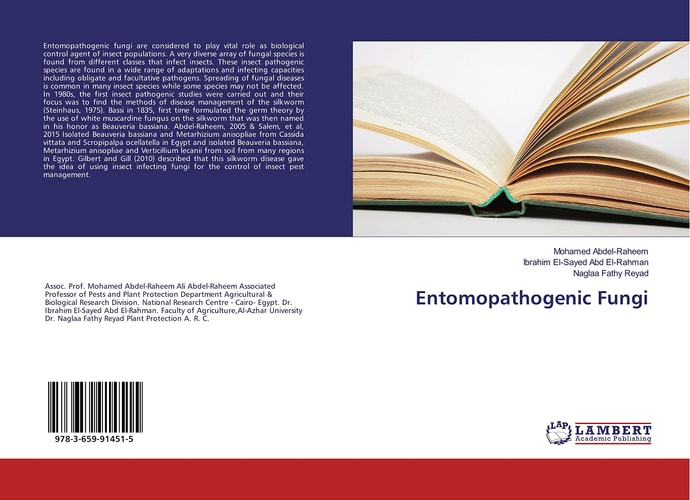
Entomopathogenic Fungi
0
0
As an Amazon Associate and affiliate partner, Menrva Books earns from qualifying purchases. Learn more
Author Description
Entomopathogenic fungi are considered to play vital role as biological control agent of insect populations. A very diverse array of fungal species is found from different classes that infect insects. These insect pathogenic species are found in a wide range of adaptations and infecting capacities including obligate and facultative pathogens. Spreading of fungal diseases is common in many insect species while some species may not be affected. In 1980s, the first insect pathogenic studies were carried out and their focus was to find the methods of disease management of the silkworm (Steinhaus, 1975). Bassi in 1835, first time formulated the germ theory by the use of white muscardine fungus on the silkworm that was then named in his honor as Beauveria bassiana. Abdel-Raheem, 2005 & Salem, et al, 2015 Isolated Beauveria bassiana and Metarhizium anisopliae from Cassida vittata and Scropipalpa ocellatella in Egypt and isolated Beauveria bassiana, Metarhizium anisopliae and Verticillium lecanii from soil from many regions in Egypt. Gilbert and Gill (2010) described that this silkworm disease gave the idea of using insect infecting fungi for the control of insect pest management.
Menrva's Summary
THE THESIS
This book investigates the critical role of entomopathogenic fungi as biological control agents against insect populations. It details the diverse array of fungal species from various classes that infect insects, distinguishing between obligate and facultative pathogens and their varying capacities. The text traces the historical development of insect pathogenic studies, beginning with early research on silkworm diseases and the formulation of the germ theory by Bassi, and highlights key isolations of fungi like Beauveria bassiana and Metarhizium anisopliae from specific insect species and soil samples in Egypt.
THE SCOPE MAP
- Detailed exploration of entomopathogenic fungi as biological control agents.
- Classification of fungal species infecting insects, including obligate and facultative pathogens.
- Historical overview of insect pathogenic studies, dating back to the 1980s and earlier.
- Discussion of Bassi's germ theory formulation using white muscardine fungus on silkworms.
- Case studies of fungal isolations from specific insect pests like Cassida vittata and Scropipalpa ocellatella.
- Identification of key fungal species such as Beauveria bassiana, Metarhizium anisopliae, and Verticillium lecanii.
- Geographical focus on fungal isolation studies conducted in Egypt.
- The foundational role of silkworm disease research in developing insect pest management strategies.
THE AUTHORITY PERSPECTIVE
This work appears to be a specialized academic text focusing on the scientific and historical aspects of entomopathogenic fungi. Its detailed discussion of specific fungal species, historical research, and case studies suggests it is aimed at researchers, students, and professionals in entomology, mycology, and pest management. The inclusion of historical context and specific research findings indicates a thorough approach to the subject matter.
Page Count:
120
Publication Date:
2016-06-30
Publisher:
LAP LAMBERT Academic Publishing
ISBN-10:
3659914517
ISBN-13:
9783659914515
Science
Non-Fiction
Mycology
Entomology
Community Tags
Similar Books