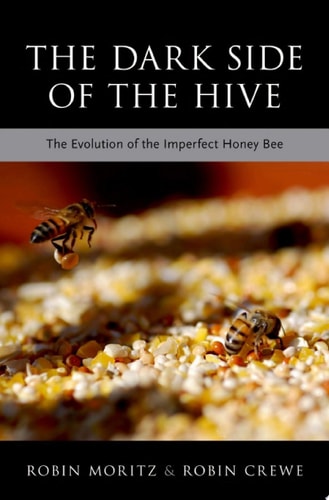
The Dark Side of the Hive: The Evolution of the Imperfect Honeybee
0
0
As an Amazon Associate and affiliate partner, Menrva Books earns from qualifying purchases. Learn more
Author Description
Honey bees have been described as exceptionally clever, well-organized, mutualistic, collaborative, busy, efficient--in short a perfect society. While the colony is indeed a marvel of harmonious, efficient organization, it also has a considerable dark side. Authors Robin Moritz and Robin Crewe write about the life history of the honey bee, Apis mellifera, highlighting conflict rather than harmony, failure rather than success, from the perspective of the individual worker in the colony. When one looks carefully, the honey bee colony is far from being perfect. As with any complex social system, honeybee societies are prone to error, robbery, cheating, and social parasitism. Nevertheless, the hive gets by remarkably well in spite of many seemingly odd biological features. The perfection that is perceived to exist in the honeybee's social organization is the function of a focus on the colony as a whole rather than exploring the idiosyncrasies of its individual members. The Dark Side of the Hive thus focuses on the role of the individual rather than that of the collective. Moritz and Crewe dissect the various careers that individual male and female honey bees can take and their role in colony organization. Competition between individuals using both physical and chemical force drives colonial organization. This book deals with individual mistakes, maladaptations and evolutionary dead-ends that are also part of the bees' life. The story told about these dark sides of the colony spans the full range of biological disciplines ranging from genomics to systems biology.
Menrva's Summary
THE THESIS
This book investigates the biological and social mechanisms of the honeybee colony to challenge the perception of the hive as a perfectly harmonious and efficient society. Authors Robin Crewe and Robin Moritz, both established experts in social insect behavior and evolutionary biology, utilize a synthesis of genomics, systems biology, and behavioral observation to shift the analytical focus from the collective colony to the individual worker. They argue that honeybee societies are defined as much by internal conflict, competition, and maladaptation as they are by cooperation, providing a nuanced view of the species' evolutionary history.
THE SCOPE MAP
What You Will Find
- Analysis of individual career paths for male and female honeybees within the colony structure.
- Examination of competitive behaviors including robbery, cheating, and social parasitism.
- Integration of multi-disciplinary data ranging from genomics to systems biology.
Scope Limits
- The text does not provide a general guide to beekeeping or hive management.
- It does not focus on the benefits of honeybee pollination for human agriculture.
THE AUTHORITY PERSPECTIVE
Experts in entomology recognize this work as a critical counter-narrative to traditional, idealized models of social insect behavior. Readers frequently note the academic density of the prose, which is best suited for those with a background in biological sciences.
Page Count:
208
Publication Date:
2018-01-01
Publisher:
Oxford University Press
ISBN-10:
0190872306
ISBN-13:
9780190872304
Nature
Science
Evolution
Biology
Honeybee
Zoology
Evolutionary Biology
Entomology
Community Tags
Similar Books