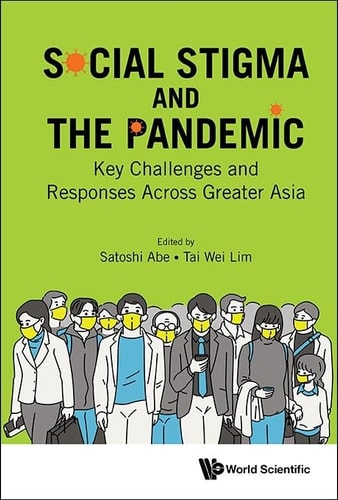
Social Stigma and the Pandemic: Key Challenges and Responses Across Greater Asia
0
0
As an Amazon Associate and affiliate partner, Menrva Books earns from qualifying purchases. Learn more
Author Description
In this book, the focus is on five Asian countries/regions (Iran, Hong Kong, South Korea, Singapore, and Japan) that show distinct approaches to combating infections. It specifically examines how the recent pandemic arose stigma in the context of history and sociocultural relations, how it is discussed and problematized among locals, and how disparate institutions and individuals mobilized to address it. A global comparative analysis across Greater Asia is presented in this book through the contributions of experts from multiple fields who have researched extensively in each region.
Menrva's Summary
THE THESIS
This book investigates the complex interplay between social stigma and public health responses during the recent pandemic across five distinct regions in Greater Asia. It examines how historical and sociocultural factors shaped the emergence and discussion of stigma among local populations, and details the varied institutional and individual efforts to address these challenges in Iran, Hong Kong, South Korea, Singapore, and Japan. The work presents a comparative analysis drawing on the expertise of scholars specializing in each region, offering a multifaceted perspective on a critical global issue.
THE SCOPE MAP
- Analysis of social stigma in Iran, Hong Kong, South Korea, Singapore, and Japan during the pandemic.
- Exploration of historical and sociocultural roots of pandemic-related stigma.
- Examination of local discourse and problematization of stigma.
- Documentation of institutional and individual mobilization to combat stigma.
- Comparative analysis of distinct pandemic response strategies across Greater Asia.
- Contributions from experts with extensive regional research experience.
THE AUTHORITY PERSPECTIVE
This comparative study offers a timely and in-depth examination of social stigma during a global health crisis, drawing on regional expertise to provide nuanced insights. The multi-disciplinary approach and focus on specific Asian contexts promise a valuable resource for understanding the socio-cultural dimensions of pandemics. The book's structured comparison across diverse regions is likely to appeal to academics, policymakers, and public health professionals interested in Asia and global health challenges.
Page Count:
186
Publication Date:
2024-07-01
Publisher:
World Scientific Publishing Company Pte Limited
ISBN-10:
9811284601
ISBN-13:
9789811284601
History
Politics
Non-Fiction
Pandemics
Social Stigma
Sociology
Asian Studies
Public Health
Community Tags
Similar Books