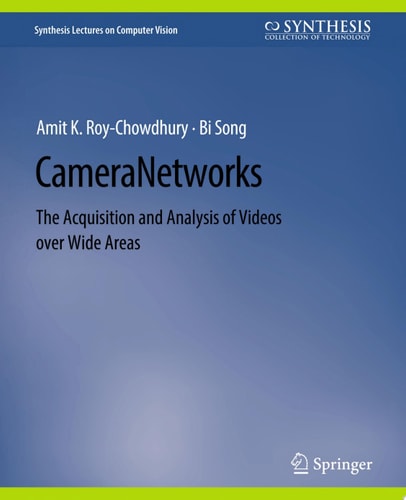
Camera Networks
0
0
As an Amazon Associate and affiliate partner, Menrva Books earns from qualifying purchases. Learn more
Author Description
As networks of video cameras are installed in many applications like security and surveillance, environmental monitoring, disaster response, and assisted living facilities, among others, image understanding in camera networks is becoming an important area of research and technology development. There are many challenges that need to be addressed in the process. Some of them are listed below: - Traditional computer vision challenges in tracking and recognition, robustness to pose, illumination, occlusion, clutter, recognition of objects, and activities; - Aggregating local information for wide area scene understanding, like obtaining stable, long-term tracks of objects; - Positioning of the cameras and dynamic control of pan-tilt-zoom (PTZ) cameras for optimal sensing; - Distributed processing and scene analysis algorithms; - Resource constraints imposed by different applications like security and surveillance, environmental monitoring, disaster response, assisted living facilities, etc. In this book, we focus on the basic research problems in camera networks, review the current state-of-the-art and present a detailed description of some of the recently developed methodologies. The major underlying theme in all the work presented is to take a network-centric view whereby the overall decisions are made at the network level. This is sometimes achieved by accumulating all the data at a central server, while at other times by exchanging decisions made by individual cameras based on their locally sensed data. Chapter One starts with an overview of the problems in camera networks and the major research directions. Some of the currently available experimental testbeds are also discussed here. One of the fundamental tasks in the analysis of dynamic scenes is to track objects. Since camera networks cover a large area, the systems need to be able to track over such wide areas where there could be both overlapping and non-overlapping fields of view of the cameras, as addressedi
Menrva's Summary
THE THESIS
The proliferation of networked video cameras presents significant challenges for effective image understanding and data aggregation. The book addresses core research problems in camera networks, focusing on traditional computer vision issues like tracking and recognition under varying conditions, and the aggregation of local information for wide-area scene comprehension. It also explores camera positioning and control, distributed processing, and resource constraints specific to applications such as security, environmental monitoring, and disaster response. The central theme is a network-centric approach, utilizing either centralized data accumulation or distributed decision-making among cameras.
THE SCOPE MAP
- Overview of problems and research directions in camera networks
- Discussion of currently available experimental testbeds
- Fundamental tasks in dynamic scene analysis, including object tracking across overlapping and non-overlapping camera fields of view
- Methodologies for aggregating local information for wide-area scene understanding
- Techniques for optimal sensing through camera positioning and dynamic control of PTZ cameras
- Algorithms for distributed processing and scene analysis
- Consideration of resource constraints imposed by various applications
- Network-centric decision-making strategies
THE AUTHORITY PERSPECTIVE
This book delves into the complex field of camera networks, offering a comprehensive review of current research and methodologies. It highlights the critical challenges in image understanding, tracking, and recognition within distributed systems. The authors emphasize a network-centric perspective, which is crucial for developing robust solutions for applications ranging from security to disaster response. The detailed description of methodologies and underlying themes suggests a valuable resource for researchers and practitioners in computer vision and network analysis.
Page Count:
119
Publication Date:
2022-05-31
Publisher:
Springer Nature
ISBN-10:
3031018117
ISBN-13:
9783031018114
Non-Fiction
Science & Technology
Computer Vision
Computer Science
Machine Learning
Community Tags
Similar Books