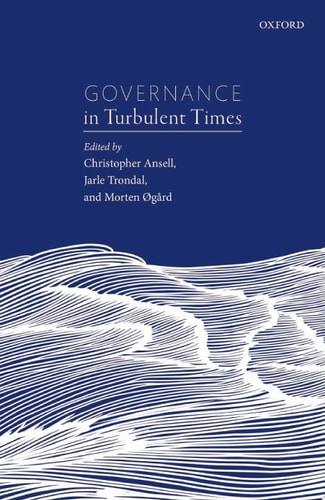
Governance in Turbulent Times
0
0
As an Amazon Associate and affiliate partner, Menrva Books earns from qualifying purchases. Learn more
Author Description
What are the conditions for political development and decay, and the likelihood of sustained political order? What are the limits of established rule as we know it? How much stress can systems tackle before they reach some kind of limit? How do governments tackle enduring ambiguity and uncertainty in their systems and environments? These are some of the big questions of our time. Governance in turbulent times may serve as a stress-test of well-known ways of governing in the 21st century. Governance in Turbulent Times discusses this pertinent challenge and suggests how governments and organizations cope with and live with turbulence. The book explores how organizations and institutions respond to precipitous, conflicting, and novel-in short, turbulent-governance challenges. This book is a comprehensive and ground-breaking endeavor to understand how governance systems respond to turbulent challenges, and how turbulent times provide excellent opportunities to investigate the sustainability of governance systems. The book illustrates how politics, administrative scale and complexity, uncertainty, and time constraints can collide to produce turbulence. Building on prior work in organization theory and political science, we argue that turbulence refers to four properties related to the interaction of demands for action: variability, consistency, expectation, and unpredictability. Turbulence occurs where the interaction of demands is experienced as highly variable, inconsistent, unexpected, and/or unpredictable.
Menrva's Summary
THE THESIS
This book investigates the capacity of governance systems to maintain order and functionality when confronted with extreme environmental and political turbulence. The authors, Christopher K. Ansell, Jarle Trondal, and Morten Øgård, utilize established frameworks from organization theory and political science to analyze how institutions manage ambiguity. They propose that turbulence is defined by the interaction of four specific properties: variability, inconsistency, expectation, and unpredictability.
THE SCOPE MAP
What You Will Find
- A theoretical framework defining turbulence through four distinct interaction properties.
- Analysis of how administrative scale and complexity influence institutional responses.
- Examination of the collision between time constraints and political decision-making.
Scope Limits
- The text does not provide a prescriptive manual for crisis management in specific localized government sectors.
- It does not offer a comprehensive historical survey of all global political collapses.
THE AUTHORITY PERSPECTIVE
Experts identify this work as a significant contribution to the study of institutional resilience and administrative theory. Readers frequently note the academic density of the prose, which makes it a suitable resource for scholars and advanced students of political science.
Page Count:
320
Publication Date:
2016-01-01
Publisher:
OUP Oxford
ISBN-10:
0192508881
ISBN-13:
9780192508881
Organization Theory
Public Administration
Governance
Public Policy
Community Tags
Other Editions(3)

Similar Books







Reader Comments
Share Your Thoughts
No comments yet. Be the first to share your thoughts!