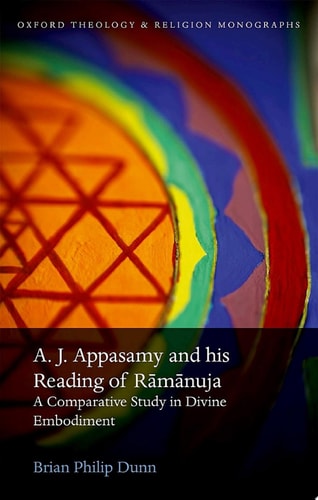
A. J. Appasamy and His Reading of Rāmānuja: A Comparative Study in Divine Embodiment
0
0
As an Amazon Associate and affiliate partner, Menrva Books earns from qualifying purchases. Learn more
Author Description
In this work, Brian Philip Dunn focuses on the embodiment theology of the South Indian theologian, A. J. Appasamy (1891-1975). Appasamy developed what he called a 'bhakti' (devotional) approach to Christian theology, bringing his own primary text, the Gospel of John, into comparative interaction with the writings of the Hindu philosopher and theologian, Rāmānuja. Dunn's exposition here is of Appasamy's distinctive adaptation of Rāmānuja's 'Body of God' analogy and its application to a bhakti reading of John's Gospel. He argues throughout for the need to locate and understand theological language as embedded and embodied within the narrative and praxis of tradition and, for Appasamy and Rāmānuja, in their respective Anglican and Śrivaiṣṇava settings. Responding to Appasamy, Dunn proposes that the primary Johannine referent for divine embodiment is the temple and considers recent scholarship on Johannine 'temple Christology' in light of Śrivaiṣṇava conceptions of the temple and the temple deity. He then offers a constructive reading of the text as a temple procession, a heuristic device that can be newly considered in both comparative and devotional contexts today.
Menrva's Summary
THE THESIS
This work investigates the theological synthesis of A. J. Appasamy, specifically examining how he utilized Rāmānuja’s philosophy to articulate a Christian theology of divine embodiment. Brian Philip Dunn, a scholar of theology, analyzes the intersection of Anglican tradition and Śrivaiṣṇava thought. By focusing on the 'Body of God' analogy, the author argues that theological language must be understood within the specific narrative and praxis of its originating tradition.
THE SCOPE MAP
What You Will Find
- Comparative analysis of the Gospel of John and Rāmānuja’s philosophical writings
- Examination of 'temple Christology' in relation to Śrivaiṣṇava temple deity concepts
- A constructive proposal for reading the Gospel of John as a temple procession
Scope Limits
- The study is restricted to the specific theological framework of A. J. Appasamy
- It does not provide a comprehensive history of all Hindu-Christian comparative theology
THE AUTHORITY PERSPECTIVE
Scholars in the field of comparative theology recognize this monograph as a rigorous examination of Appasamy’s specific contribution to interreligious dialogue. Readers frequently note the academic density of the prose, which assumes a foundational knowledge of both Johannine studies and Indian philosophy.
Page Count:
327
Publication Date:
2016-01-01
Publisher:
OUP Oxford
ISBN-10:
0192508962
ISBN-13:
9780192508966
Philosophy
Religion
Hinduism
Christianity
Theology
Community Tags
Similar Books