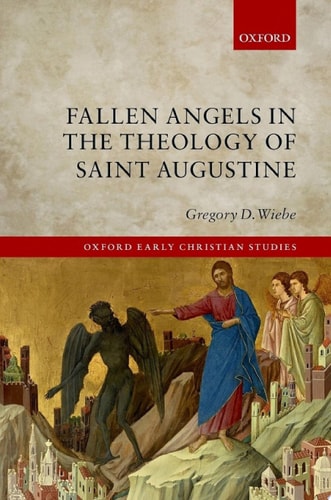
Fallen Angels in the Theology of St Augustine
0
0
As an Amazon Associate and affiliate partner, Menrva Books earns from qualifying purchases. Learn more
Author Description
This book ventures to describe Augustine of Hippo's understanding of demons, including the theology, angelology, and anthropology that contextualize it. Demons are, for Augustine as for the Psalmist (95:5 LXX) and the Apostle (1 Cor 10:20), the "gods of the nations." This means that Augustine's demons are best understood neither when they are "spiritualized" as personifications of psychological struggles, nor in terms of materialist contagions that undergird a superstitious moralism. Rather, because the gods of the nations are the paradigm of demonic power and influence over humanity, Augustine sees the Christian's moral struggle against them within broader questions of social bonds, cultural form, popular opinion, philosophical investigation, liturgical movement, and so forth. In a word, Augustine's demons have a religious significance, particularly in its Augustinian sense of bonds and duties between persons, and between persons and that which is divine. Demons are a highly integrated component of his broader theology, rooted in his conception of angels as the ministers of all creation under God, and informed by the doctrine of evil as privation and his understanding of the fall, his thoughts on human embodiment, desire, visions, and the limits of human knowledge, as well as his theology of religious incorporation and sacraments. As false mediators, demons are mediated by false religion, the body of the devil, which Augustine opposes with an appeal to the true mediator, Christ, and the true religion of his body, the church.
Menrva's Summary
THE THESIS
This book investigates the theological framework of Augustine of Hippo regarding the nature, function, and religious significance of demons within his broader angelology and anthropology. Gregory D. Wiebe, a scholar of early Christian thought, examines how Augustine positions demons as the "gods of the nations" to illustrate the conflict between false religious mediation and the true mediation of Christ. By situating these entities within Augustine's doctrine of evil as privation and his theories on social bonds, the author argues that demonic influence is fundamentally a matter of religious duty and cultural formation rather than mere superstition or psychological metaphor.
THE SCOPE MAP
What You Will Find
- An analysis of Augustine's angelology and the hierarchy of creation.
- Examination of the relationship between demonic power and the "body of the devil" versus the church.
- Integration of Augustine's views on human embodiment, desire, and the limits of knowledge.
- Contextualization of demons within the framework of liturgical movement and social bonds.
Scope Limits
- The text does not provide a general history of demonology outside of the specific Augustinian context.
- It does not focus on the evolution of demonic imagery in later medieval or modern theology.
THE AUTHORITY PERSPECTIVE
Scholars recognize this work as a rigorous contribution to the Oxford Early Christian Studies series, noted for its precise handling of complex patristic texts. Readers frequently highlight the author's ability to synthesize Augustine's disparate thoughts on evil and religion into a coherent theological system.
Page Count:
276
Publication Date:
2021-01-01
Publisher:
OUP Oxford
ISBN-10:
0192661140
ISBN-13:
9780192661142
Philosophy
Religion
History
Patristics
Christianity
Theology