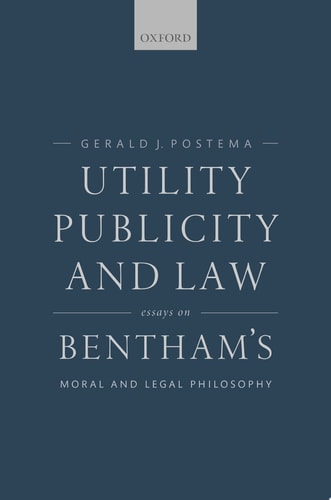
Utility, Publicity, and Law
0
0
As an Amazon Associate and affiliate partner, Menrva Books earns from qualifying purchases. Learn more
Author Description
The essays in this volume offer a reassessment of Jeremy Bentham's strikingly original legal philosophy. Early on, Bentham discovered his 'genius for legislation' - 'legislation' included not only lawmaking and code writing, but also political and social institution building and engineering of public spaces for effective control of the exercise of political power. In his general philosophical work, Bentham sought to articulate a public philosophy to guide and direct all of his 'legislative' efforts. Part I explores the philosophical foundations of his public philosophy: his theory of meaning and framework for analysis and definition of key concepts, his theory of human affections and motivations, and his utilitarian theory of value. It is argued that, while concepts of pleasure and happiness play nominal roles in his theory of value, concepts of publicity, equality, and interests emerge as the dominant concepts of his public philosophy. Part II explores several dimensions of Bentham's jurisprudence, including his radically revised command model of law, his early reflections on justice and law in adjudication, his theories of judicial evidence, constitutional rights, the rule of law, and international law. The concluding essay demonstrates the centrality of the notion of publicity in his moral, legal and political thought. Emerging from this study is a positivist legal theory and a utilitarian moral-political philosophy that challenge in fundamental ways contemporary understandings of those doctrines.
Menrva's Summary
THE THESIS
This work investigates the core components of Jeremy Bentham's legal and political philosophy, specifically re-evaluating the role of publicity, equality, and interests within his utilitarian framework. Gerald J. Postema, a scholar of legal philosophy, utilizes a systematic analysis of Bentham's writings to challenge conventional interpretations of his positivist legal theory. By examining both the philosophical foundations and the practical applications of Bentham's legislative efforts, the author argues that traditional readings of Bentham's utilitarianism often overlook the structural importance of public accountability and institutional design.
THE SCOPE MAP
What You Will Find
- A detailed examination of Bentham's theory of meaning and human motivation.
- An analysis of the command model of law and its revisions.
- Discussions on judicial evidence, constitutional rights, and international law.
- A synthesis of Bentham's public philosophy as a tool for social engineering.
Scope Limits
- The text does not provide a comprehensive biography of Bentham's life.
- It does not focus on the historical reception of Bentham's work in the 19th century.
THE AUTHORITY PERSPECTIVE
Scholars and legal theorists frequently cite this volume as a significant contribution to the study of Bentham's jurisprudence. Readers often note the academic density of the prose, which is intended for those with a background in political philosophy or legal history.
Page Count:
335
Publication Date:
2019-01-01
Publisher:
Oxford University Press
ISBN-10:
0192511580
ISBN-13:
9780192511584
Philosophy
Political Philosophy
Jurisprudence
Utilitarianism
Legal Theory
Philosophy history
Community Tags
Similar Books