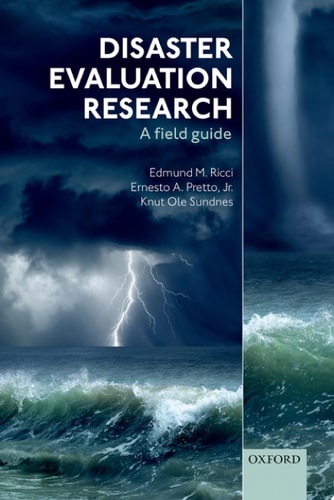
Disaster Evaluation Research: A Field Guide
0
0
As an Amazon Associate and affiliate partner, Menrva Books earns from qualifying purchases. Learn more
Author Description
A Human Disaster Is Defined As A Hazardous Event That Overwhelms The Capacity Of The Local Community To Respond To The Needs Of The Affected Population. Medical And Public Health Responses Aim To Provide Care Efficiently And Promptly But All Too Often, Responses Are Hampered By Recurring Mistakes. Analysing The Factors At Play Such As The Scale And Frequency Of Disasters And The Variety Of Challenges They Present, Is Central To Developing More Effective Response Plans. However The Complexity Of Disasters Often Precludes Reliable Data Collection, Hampering The Accuracy Of The Results, Conclusions And Recommendations Required To Improve Responses. Disaster Evaluation Research: A Field Guide Presents A New Approach To The Study Of Disaster By Incorporating A Mixed-methods Research Approach. This Practical Manual Provides A Range Of Reliable Methods, Robust Approaches And Proven Techniques For The Gathering And Analyzing Of Data. Written By Leading Evaluation Scientists With A Wealth Of Experience, The Authors Present Their 'eight Step Model' For Disaster Evaluation Studies. This Framework Applies Evaluation Science To Disaster Responses, Helping Scientists To Select Key Stakeholders Effectively, Write Evaluation Questions, Use Logic Models And Mixed-methods Research Design, Prepare Sampling Plans, Collect And Analyse Data, And Prepare A Final Report. This Guide Also Features Useful Tools For Carrying Out Evaluations Including; Evaluation Questions, Indicators And Data Sources, Resources, And Questionnaires Used In Past Evaluation Studies. Using A Clear, Accessible And Step-by-step Style This Practical Manual Is Easy To Use In The Field And Essential Reading For Medical And Public Health Professionals Involved In Disaster Preparedness And Response, Humanitarian Relief Workers, Policy Analysts, Evaluation Scientists And Epidemiologists.
Menrva's Summary
THE THESIS
How can researchers and humanitarian professionals overcome the inherent complexity of disaster environments to conduct reliable, data-driven evaluations of response efforts? The authors, a team of experienced evaluation scientists and public health experts, argue that traditional data collection methods often fail in chaotic disaster settings. They propose a structured 'eight step model' that integrates mixed-methods research design to provide a rigorous framework for assessing medical and public health interventions during crises.
THE SCOPE MAP
What You Will Find
- The 'eight step model' for designing and executing disaster evaluation studies.
- Practical guidance on selecting stakeholders, formulating evaluation questions, and utilizing logic models.
- Templates for sampling plans, data collection instruments, and reporting structures.
- Real-world examples of questionnaires and indicators used in previous humanitarian relief efforts.
Scope Limits
- The text focuses primarily on medical and public health responses rather than broader geopolitical or military disaster management strategies.
- It does not provide exhaustive coverage of long-term post-disaster recovery or reconstruction policy.
THE AUTHORITY PERSPECTIVE
Experts in the field of humanitarian relief and public health recognize this manual as a practical, field-oriented resource for practitioners who need to implement rigorous research under time-sensitive constraints. Readers frequently note that the step-by-step structure makes complex evaluation science accessible for those working in high-pressure, resource-limited environments.
Page Count:
224
Publication Date:
2019-01-01
Publisher:
Oxford University Press
ISBN-10:
0192517015
ISBN-13:
9780192517012
Social Science
Epidemiology
Public Health
Community Tags
Other Editions(2)
Similar Books

Reader Comments
Share Your Thoughts
No comments yet. Be the first to share your thoughts!