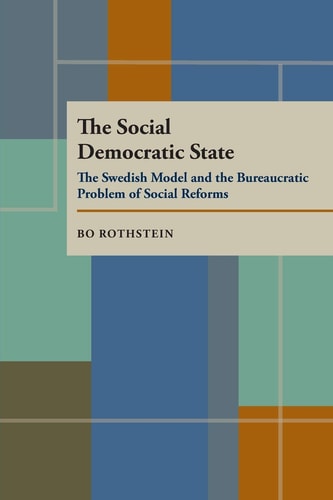
The Social Democratic State: Swedish Model And The Bureaucratic Problem
0
0
As an Amazon Associate and affiliate partner, Menrva Books earns from qualifying purchases. Learn more
Author Description
The Swedish Social Democratic Party, the SAP, is the most successful social democratic party in the world. It has led the government for most of the last six decades, participating either alone or as the dominant force in coalition government. The SAP has also worked closely with trade unions that have organized nearly 85 percent of the labor force, the highest rate among the advanced industrial democracies. Rarely has a political party been so dominant or so closely linked to labor movement. Yet Sweden remains very much a capitolist society with economic and social power firmly in the hands of big capitol. If one wants to know if politics, and most especially if reformist politics, matters - if, that is, political mobilization can change democratic capitolists societies - then Sweden under the Social Democrats is clearly one of the best empirical cases to study. Bo Rothstein uses the Swedish experience to analyze the limits a social democratic government labors under and the possibilities it enjoys in using the state to implement large-scale social change. He examines closely two SAP programs, one a success and the other a failure, that attempted to change social processes deeply embedded in capitolist society. He ties the outcomes of these programs to the structure of the state and hypothesizes that the outcome depends, to a considerable extent, on how administrative apparatuses responsible for implementing each policy are organized. Rothstein concludes that no matter how wisely a reformist policy is designed nor how strong the political party behind it, if the administrative arrangements are faulty, it will fail at the stage of implementation. Rothstein convincingly demonstrates that the democratic capitolist countries of the world have important lessons to learn from the Swedish experience regarding the possibilities for political reform. Political scientists and political reformers alike can learn much from Rothstein’s deep knowled
Menrva's Summary
THE THESIS
This book investigates the inherent challenges and limitations faced by social democratic governments in implementing large-scale social change within capitalist societies, using Sweden as a primary case study. Bo Rothstein, a political scientist, examines the Swedish Social Democratic Party's (SAP) extensive history of governance and its close ties with a highly organized labor force. The analysis focuses on two specific SAP programs, one successful and one failed, to understand why ambitious reforms can falter. Rothstein posits that the success or failure of such policies is heavily dependent on the organizational structure of the administrative apparatuses responsible for their implementation, suggesting that faulty administrative arrangements can doom even the wisest policies at the implementation stage.
THE SCOPE MAP
- Analysis of the Swedish Social Democratic Party (SAP) and its long-standing political dominance.
- Examination of the relationship between the SAP and trade unions, noting the high labor organization rate in Sweden.
- Detailed study of two distinct SAP programs, one achieving success and the other failing.
- Hypothesis on the critical role of administrative apparatus organization in policy implementation outcomes.
- Exploration of the limits and possibilities for social democratic governments to enact change in capitalist systems.
- Discussion of lessons learned from the Swedish experience for political reform in democratic capitalist countries.
- Focus on the implementation phase as a crucial determinant of policy success or failure.
THE AUTHORITY PERSPECTIVE
The book is regarded as a significant contribution to the study of social democratic governance and policy implementation. Rothstein's detailed analysis of the Swedish model provides valuable insights into the practical challenges of enacting social change within established capitalist structures. Political scientists and reformers are likely to find the examination of program successes and failures, particularly the emphasis on administrative organization, highly instructive. The work offers a nuanced perspective on the effectiveness of reformist politics and the conditions under which it can succeed or falter.
Page Count:
243
Publication Date:
1998-02-27
Publisher:
University of Pittsburgh Press
ISBN-10:
0822956748
ISBN-13:
9780822956747
Non-Fiction
Politics
History
Sociology
Social policy
Community Tags
Similar Books