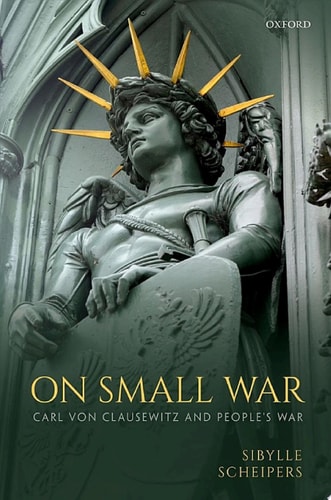
On Small War: Carl von Clausewitz and People's War
0
0
As an Amazon Associate and affiliate partner, Menrva Books earns from qualifying purchases. Learn more
Author Description
Carl von Clausewitz has long been interpreted as the paradigmatic thinker of major interstate war. This book challenges this assumption by showing that Clausewitz was an ardent analyst of small war and integrated many aspects of his early writings on partisan warfare and people's war into his magnum opus, On War. It reconstructs Clausewitz's intellectual development by placing it in the context of his engagement with the political and philosophical currents of his own times - German Idealism, Romanticism, and Humanism. The central question that Clausewitz and his contemporaries faced was how to defend Prussia and Europe against Napoleon's expansionist strategy. On the one hand, the nationalization of war that had occurred as a result of the French Revolution could only be countered by drawing the people into the defence of their own countries. On the other, this risked a descent into anarchy and unchecked terror, as the years 1793 and 1794 in France had shown. Throughout his life Clausewitz remained optimistic that the institution of the Prussian Landwehr could achieve both an effective defence of Prussia and a social and political integration of its citizens. Far from leaving behind his early advocacy of people's war, Clausewitz integrated it systematically into his mature theory of war. People's war was war in its existential form; it risked escalating into 'absolute war'. However, if the threat of defensive people's war had become a standard option of last resort in early-nineteenth century Europe, it could also function as a safeguard of the balance of power.
Menrva's Summary
THE THESIS
This book investigates whether Carl von Clausewitz, traditionally viewed as a theorist of interstate conflict, fundamentally integrated the concepts of small war and people's war into his broader military philosophy. Sibylle Scheipers, a scholar of military history and political theory, reconstructs Clausewitz's intellectual evolution by situating his writings within the philosophical landscape of German Idealism, Romanticism, and Humanism. The text argues that Clausewitz viewed the mobilization of the populace not merely as a tactical necessity against Napoleonic expansion, but as a complex political instrument that required careful management to avoid the anarchy of revolutionary terror.
THE SCOPE MAP
What You Will Find
- Analysis of Clausewitz's early writings on partisan warfare compared to his later work in On War.
- Examination of the Prussian Landwehr as a mechanism for both national defense and social integration.
- Contextualization of Clausewitz's ideas within the political climate of early 19th-century Europe.
Scope Limits
- The text does not provide a comprehensive biography of Clausewitz's entire life, focusing instead on his intellectual development regarding irregular warfare.
- It does not cover the technical evolution of weaponry or specific battlefield tactics beyond their political implications.
THE AUTHORITY PERSPECTIVE
Experts recognize this work as a significant contribution to Clausewitzian studies, particularly for its focus on the often-overlooked aspects of his theory regarding people's war. Readers frequently note the academic density of the prose, which requires a foundational understanding of 19th-century European political philosophy to fully appreciate the author's arguments.
Page Count:
184
Publication Date:
2018-01-01
Publisher:
OUP Oxford
ISBN-10:
0192519816
ISBN-13:
9780192519818
Warfare
European History
19th Century
Military History
Political Philosophy
Community Tags
Similar Books