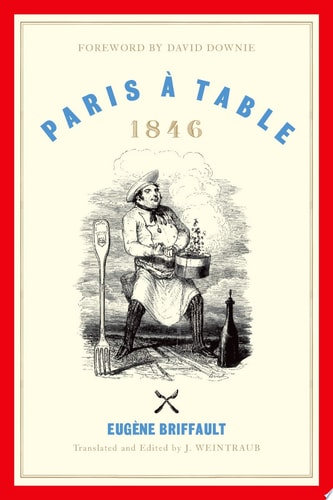
Paris à Table: 1846
0
0
As an Amazon Associate and affiliate partner, Menrva Books earns from qualifying purchases. Learn more
Author Description
Described by Le Monde as "the richest view of Balzac's time seen from the table," Paris à Table: 1846 is an essential text in the history of gastronomy, along with Brillat-Savarin's The Physiology of Taste and Dumas's Dictionary of Cuisine. Its author, Eugène Briffault, was well-known in his day as a theater critic and chronicler of contemporary Paris, but also as a bon-vivant, celebrated for his ability to quaff a bell jar full of champagne in a single draft and well-qualified to write authoritatively about the culinary culture of Paris. Focusing on the manners and customs of the dining scene, Briffault takes readers from the opulence of a meal at the Rothschilds' through every social stratum down to the student on the Left Bank and the laborer eating on the streets. He surveys the restaurants of the previous generation and his own--from the most elegant to the lowest dive--along with the eating habits of the bourgeoisie, the importance and variety of banquets, the institutional meal, and even the plight of "people who do not dine," artists and intellectuals who fell on hungry times. He records the specialties, the décor, the patrons, and the restaurateurs and their waiters. A fine storyteller, Briffault collected culinary anecdotes, from the tantrums of a king deprived of his spinach to the tragedy of "the friendliest pig that was ever seen." The volume includes the humorous drawings of the caricaturist Bertall that cleverly reinforce the witty and ironic tone of the text. Along with J. Weintraub's introduction--which provides the first modern biography of the author and analyzes the place of Paris à Table in the literary culture of the time--the text is copiously annotated, acquainting readers with the events and characters that enliven the narrative. Paris à Table provides a delightful and delectable entryway to Briffault's Paris, the city Walter Benjamin characterized as "the capital of the nineteenth century."
Menrva's Summary
THE THESIS
This work investigates the social stratification and cultural significance of the Parisian dining scene during the mid-19th century. Eugène Briffault, a noted theater critic and chronicler of Parisian life, utilizes his position as a social observer to document the habits of diners ranging from the aristocracy to the urban laborer. By examining the intersection of culinary practice and social class, the author provides a comprehensive record of the manners, institutions, and economic realities that defined the city's relationship with food in 1846.
THE SCOPE MAP
What You Will Find
- Detailed surveys of Parisian restaurants, from elite establishments to street-level dives
- Analysis of dining customs across various social strata, including the bourgeoisie and the working class
- Documentation of historical culinary anecdotes and institutional meal practices
- Illustrations by the caricaturist Bertall that provide visual context to the text
- Modern biographical and analytical introduction by J. Weintraub
Scope Limits
- The text is limited to the specific social and culinary landscape of Paris in 1846
- It does not provide a comprehensive history of French cuisine beyond the mid-19th century context
THE AUTHORITY PERSPECTIVE
Critics and historians recognize this work as a foundational text in the history of gastronomy, often cited alongside the works of Brillat-Savarin and Dumas. Readers frequently note the historical density of the prose, which serves as a primary source for understanding the social dynamics of the era.
Page Count:
272
Publication Date:
2018-01-01
Publisher:
Oxford University Press
ISBN-10:
0190842059
ISBN-13:
9780190842055
History
19th Century
Cultural History
Food writing
Gastronomy
Paris France
European History
Professional Career & Trade
Community Tags
Similar Books