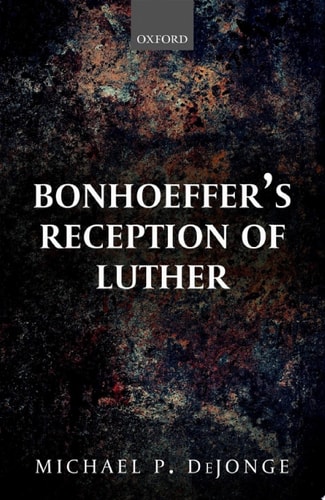
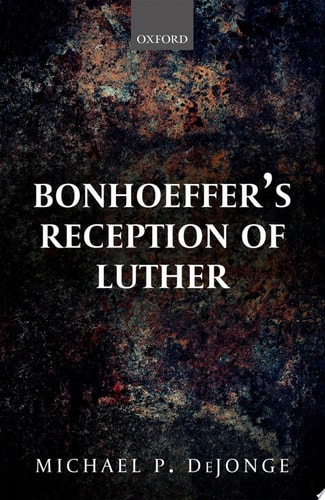
Bonhoeffer's Reception of Luther
0
0
As an Amazon Associate and affiliate partner, Menrva Books earns from qualifying purchases. Learn more
Author Description
In Dietrich Bonhoeffer's writings, Martin Luther is ubiquitous. Too often, however, Bonhoeffer's Lutheranism has been set aside with much less argumentative work than is appropriate in light of his sustained engagement with Luther. As a result, Luther remains a largely untouched hermeneutic key in Bonhoeffer interpretation. In Bonhoeffer's Reception of Luther, Michael P. DeJonge presents Bonhoeffer's Lutheran theology of justification focused on the interpersonal presence of Christ in word, sacrament, and church. The bridge between this theology and Bonhoeffer's ethical-political reflections is his two-kingdoms thinking. Arguing that the widespread failure to connect Bonhoeffer with the Lutheran two-kingdoms tradition has presented a serious obstacle in interpretation, DeJonge shows how this tradition informs Bonhoeffer's reflections on war and peace, as well as his understanding of resistance to political authority. In all of this, DeJonge argues that an appreciation of Luther's ubiquity in Bonhoeffer's corpus sheds light on his thinking, lends it coherence, and makes sense of otherwise difficult interpretive problems. What might otherwise appear as disparate, even contradictory moments or themes in Bonhoeffer's theology can often be read in terms of a consistent commitment to a basic Lutheran theological framework deployed according to dramatically changing circumstances.
Menrva's Summary
THE THESIS
This book investigates the extent to which Martin Luther's theological framework serves as the primary hermeneutic key for interpreting the writings of Dietrich Bonhoeffer. Michael P. DeJonge, a scholar specializing in Bonhoeffer's theology, utilizes a rigorous analysis of Bonhoeffer's corpus to demonstrate that his ethical and political reflections are deeply rooted in Lutheran two-kingdoms thinking. By tracing these connections, DeJonge argues that Bonhoeffer's work exhibits a consistent theological coherence that is often overlooked by scholars who treat his ideas as disparate or contradictory.
THE SCOPE MAP
What You Will Find
- An examination of Bonhoeffer's theology of justification through the lens of Christ's interpersonal presence.
- A detailed analysis of the two-kingdoms tradition as a bridge between theology and political ethics.
- Application of Lutheran frameworks to Bonhoeffer's specific stances on war, peace, and resistance to authority.
Scope Limits
- The text does not provide a general biography of Bonhoeffer's life outside of his theological development.
- It does not attempt to reconcile Bonhoeffer's work with non-Lutheran theological traditions.
THE AUTHORITY PERSPECTIVE
Scholars in the field of systematic theology identify this work as a significant contribution to the study of Bonhoeffer's intellectual development. Readers frequently note the academic density of the prose, which is intended for those already familiar with the primary theological texts of both Luther and Bonhoeffer.
Page Count:
293
Publication Date:
2017-01-01
Publisher:
OUP Oxford
ISBN-10:
019251881X
ISBN-13:
9780192518811
Biography
Religion
Philosophy
Philosophical theology
Church
Christian History
Lutheranism
Influence Literary artistic etc
Ethics
Theology
Community Tags
Other Editions(3)

Similar Books