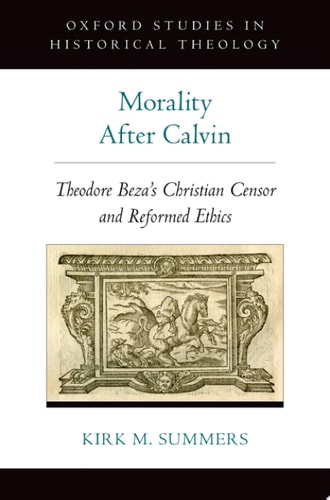
Morality After Calvin
0
0
As an Amazon Associate and affiliate partner, Menrva Books earns from qualifying purchases. Learn more
Author Description
In Morality After Calvin, Kirk M. Summers examines the development of ethical thought in the Reformed Orthodox tradition immediately following the death of Calvin. Framed around a previously unstudied poetic work of French theologian Theodore Beza, the Cato Censorius Christianus (1591), and read in conjunction with the works and correspondence of Beza and his colleagues, the book reveals the theoretical underpinnings of the disciplinary activity during the period. The poems of the Cato show that the moral fervor of the latter half of the sixteenth century had its genesis in a well-formulated theology that viewed a Christian's sanctification as a process of restoration to an original order created by God. For Beza the Christian life does not end with grace and salvation, but begins there. The principles of morality, in this theoretical framework, look back to the very moment of creation, when God structured human relationships, established a certain order in nature, and issued commands. The Mosaic Law and Christ himself embody these principles, which include an ethos of listening, sincerity of life, engagement with one's calling, love of neighbor, respect for divine order, and a desire for the purity of the flock. With insight and dexterity, as well as the use of previously unavailable sources, Summers contributes this significant volume to the study of Beza and his place in the history of the Reformed Orthodoxy.
Menrva's Summary
THE THESIS
This book investigates the theoretical foundations of ethical thought and disciplinary activity within the Reformed Orthodox tradition following the death of John Calvin. Kirk M. Summers, an academic scholar, utilizes a previously unstudied poetic work by Theodore Beza, the Cato Censorius Christianus (1591), to reconstruct the moral framework of the late sixteenth century. By analyzing this text alongside the correspondence and theological writings of Beza and his contemporaries, Summers argues that Reformed morality was rooted in a theology of sanctification as a restoration to a divinely created order.
THE SCOPE MAP
What You Will Find
- An analysis of Theodore Beza's Cato Censorius Christianus.
- An examination of the relationship between Reformed theology and moral discipline.
- A study of the concepts of sanctification, Mosaic Law, and divine order in the sixteenth century.
Scope Limits
- The book focuses primarily on the Reformed Orthodox tradition and does not provide a comprehensive history of all Protestant ethical thought.
- The analysis is centered on the specific period immediately following Calvin's death and does not extend into later developments of Reformed ethics.
THE AUTHORITY PERSPECTIVE
Scholars in the field of Reformation history recognize this work as a specialized contribution to the study of Theodore Beza and the evolution of Reformed orthodoxy. Readers frequently note the academic density of the prose and the author's reliance on primary source materials to support his historical arguments.
Page Count:
400
Publication Date:
2016-01-01
Publisher:
Oxford University Press
ISBN-10:
0190280085
ISBN-13:
9780190280086
History
Theology
Reformed Orthodoxy
Christian History
Theodore Beza
Ethics
Community Tags
Similar Books