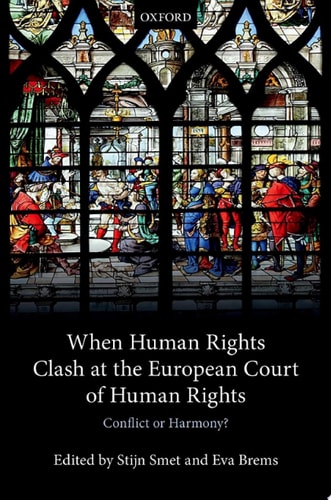
When Human Rights Clash at the European Court of Human Rights: Conflict or Harmony?
0
0
As an Amazon Associate and affiliate partner, Menrva Books earns from qualifying purchases. Learn more
Author Description
The notion of conflict rests at the heart of the judicial function. Judges are routinely asked to resolve disputes and defuse tensions. Yet, when judges are called upon to adjudicate a purported conflict between human rights, they face particular challenges and must address specific questions. Some of these concern the very existence of human rights conflicts. Can human rights really conflict with one another, in terms of mutual incompatibility? Or should human rights be interpreted in harmony with one another? Other questions concern the resolution of real conflicts. To the extent that human rights do conflict, how should these conflicts be resolved? To what extent is balancing desirable? And if it is desirable, which understanding of balancing should judges employ? This book seeks to provide both theoretical and practical answers to these questions. When Human Rights Clash at the European Court of Human Rights: Conflict or Harmony? debates both the existence and resolution of human rights conflicts, in the specific context of the case law of the European Court of Human Rights. The contributors put forth principled and pragmatic arguments and propose theoretical as well as practical approaches, whilst firmly embedding their proposals in the case law of the European Court. Doing so, this book provides concrete ways forward in the ongoing debate on conflicts of rights at Europe's human rights court.
Menrva's Summary
THE THESIS
This book investigates whether human rights can fundamentally conflict with one another and establishes a framework for how the European Court of Human Rights should resolve such disputes. Editors Eva Brems and Stijn Smet, both established scholars in human rights law, curate a collection of essays that analyze the judicial function within the European system. The text evaluates the tension between interpreting rights in harmony versus acknowledging inherent incompatibility, ultimately proposing both theoretical models and practical methodologies for judicial balancing.
THE SCOPE MAP
What You Will Find
- Analysis of the case law of the European Court of Human Rights regarding conflicting rights.
- Theoretical frameworks for understanding the nature of human rights conflicts.
- Practical methodologies for judicial balancing and conflict resolution.
- Comparative perspectives on legal interpretation within international human rights systems.
Scope Limits
- The analysis is strictly confined to the jurisprudence of the European Court of Human Rights.
- The text does not provide a comprehensive history of human rights law outside of the context of judicial conflict resolution.
THE AUTHORITY PERSPECTIVE
Legal scholars and practitioners frequently cite this work as a foundational text for understanding the complexities of rights-balancing in European jurisprudence. Experts highlight the academic density of the prose, noting that it serves as a critical resource for those engaged in advanced legal research or judicial practice.
Page Count:
283
Publication Date:
2017-01-01
Publisher:
OUP Oxford
ISBN-10:
0192515691
ISBN-13:
9780192515698
Professional Career & Trade
International Law
Law
Jurisprudence
Human rights
European Law
Community Tags
Similar Books