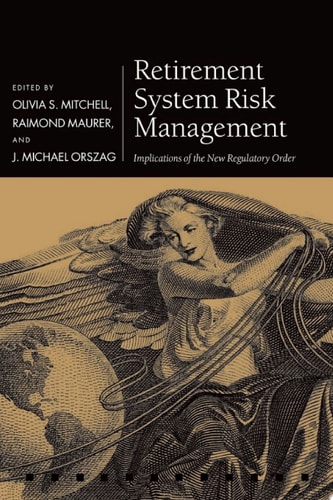
Retirement System Risk Management: Implications of the New Regulatory Order
0
0
As an Amazon Associate and affiliate partner, Menrva Books earns from qualifying purchases. Learn more
Author Description
In the wake of the worst financial crisis since the Great Depression, lawmakers and regulators around the world have changed the playbook for how banks and other financial institutions must manage their risks and report their activities. The US Congress passed the Dodd-Frank Wall Street Reform and Consumer Protection Act, and the European System of Financial Supervision (ESFS) is also crafting a framework to supervise regulated financial sector institutions including banks, insurers, pension funds, and asset managers. The implosion of the financial sector has also prompted calls for accounting changes from those seeking to better understand how assets and liabilities are reported. Initially banks were seen by many as the most important focus for regulatory reform, but other institutions are now attracting policymaker attention. There is logic to this in terms of managing systemic risk and ensuring a level playing field that avoids arbitrage between institutional structures. Yet the nature of pension and insurer liabilities is so different from that of bank liabilities that careful attention is needed in drafting appropriate rules. The new rules are having both direct and spill-over effects on retirement systems around the world. The first half of this volume undertakes an assessment of how global responses to the financial crisis are potentially altering how insurers, pension plan sponsors, and policymakers will manage risk in the decades to come. The second half evaluates developments in retirement saving and retirement products, to determine which and how these might help meet shortfalls in retirement provision.
Menrva's Summary
THE THESIS
This volume investigates how post-financial crisis regulatory frameworks, such as the Dodd-Frank Act and the ESFS, fundamentally alter the risk management strategies of global retirement systems. The authors, J. Michael Orszag, Olivia S. Mitchell, and Raimond Maurer, leverage their expertise in pension economics and financial regulation to analyze the intersection of systemic risk, institutional liability, and retirement security. They argue that while banking regulations provide a template for reform, the unique nature of pension and insurance liabilities necessitates a distinct, nuanced approach to policy drafting.
THE SCOPE MAP
What You Will Find
- Comparative analysis of global regulatory responses to the 2008 financial crisis.
- Evaluation of risk management practices for pension plan sponsors and insurers.
- Assessment of emerging retirement saving products and their efficacy in addressing funding shortfalls.
Scope Limits
- The text does not provide a comprehensive guide for individual retail investors.
- It does not cover specific tax law changes beyond the scope of systemic regulatory reform.
THE AUTHORITY PERSPECTIVE
Experts identify this work as a critical resource for policymakers and institutional finance professionals navigating the complexities of post-crisis pension regulation. Readers frequently note the academic density of the prose, which is tailored for those with a background in economics or financial policy.
Page Count:
216
Publication Date:
2016-01-01
Publisher:
OUP Oxford
ISBN-10:
0192512331
ISBN-13:
9780192512338
Economics
Public Policy
Retirement
Finance
Community Tags
Similar Books