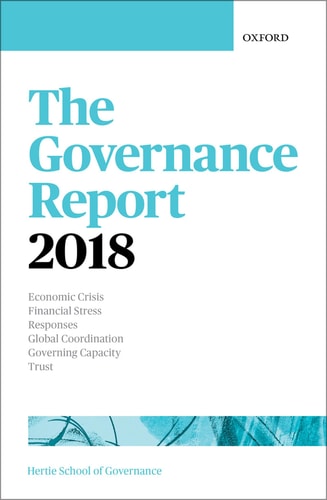
The Governance Report 2018
0
0
As an Amazon Associate and affiliate partner, Menrva Books earns from qualifying purchases. Learn more
Author Description
The Global Financial Crisis (GFC) of 2008-9 was the greatest economic stress test since the 1940s. It put not only financial markets and currencies at risk; entire economies and political systems were threatened as the GFC soon revealed major governance shortcomings and weaknesses felt across a wide spectrum of policy fields. Globalization seemed in jeopardy, the Washington Consensus of neoliberal policies broken, and democratic backsliding set in as populism and protectionism began to take root.The GFC triggered many responses to improve governance through reforms and regulatory measures of many kinds across a wide range of fields: most prominently in finance and banking, but also in fiscal policy, trade, labor markets and social security. Ten years after the GFC, the 2018 Governance Report takes stock and asks:How have countries fared, and are they better prepared to avoid or withstand another crisis of GFC proportions? To answer this question, the 2018 Report focuses on the performance of countries before and after the GFC. Using elaborate indicator and data systems, applying state-of-the-art analytics, and covering a wide range of countries, it offers a systematic comparison of governance performance from three perspectives: What public goods are being provided, at what quality and to what effect? How ready are countries to address governance challenges in the context of globalization? What are the administrative capacities of the public sector? With measures taken before the GFC and today, these perspectives on governance performance provide important benchmarks for measuring both resilience and progress and can assist policymakers in designing effective solutions.
Menrva's Summary
THE THESIS
This report investigates whether nations have successfully improved their governance structures and resilience in the decade following the 2008-2009 Global Financial Crisis. The Hertie School of Governance utilizes a decade of comparative data to evaluate how various political systems responded to the economic stress test of the GFC. By analyzing public goods provision, globalization readiness, and administrative capacity, the authors provide a framework for assessing whether current policy reforms have effectively mitigated the risks of future systemic failures.
THE SCOPE MAP
What You Will Find
- Comparative analysis of governance performance across a diverse range of international economies.
- Quantitative indicator systems designed to measure public sector administrative capacity.
- Evaluation of public goods provision quality and effectiveness before and after the 2008 crisis.
- Assessment of national readiness to manage governance challenges within the context of modern globalization.
THE AUTHORITY PERSPECTIVE
Experts and policymakers frequently cite this report as a rigorous benchmarking tool for evaluating institutional resilience. Readers often note the high density of the analytical data, making it a foundational reference for those studying the long-term impacts of the Global Financial Crisis on public policy.
Page Count:
136
Publication Date:
2018-10-30
Publisher:
Oxford University Press
ISBN-10:
0198821492
ISBN-13:
9780198821496
Economics
Finance
Public Policy
Governance
Globalization
Public Administration
Community Tags
Other Editions(3)
Similar Books







Reader Comments
Share Your Thoughts
No comments yet. Be the first to share your thoughts!