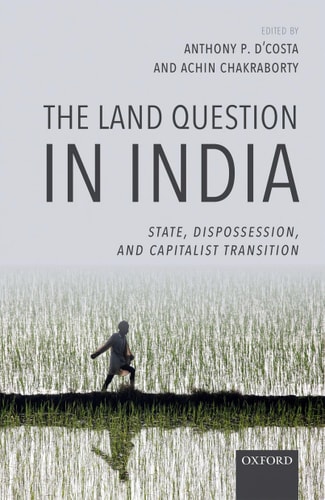
The Land Question in India
0
0
As an Amazon Associate and affiliate partner, Menrva Books earns from qualifying purchases. Learn more
Author Description
This Volume Takes A Fresh Look At The Land Question In India. Instead Of Re-engaging In The Rich Transition Debate In Which The Transformation Of Agriculture Is Seen As A Necessary Historical Step To Usher In Dynamic Capitalist (or Socialist) Development, This Collection Critically Examines The Centrality Of Land In Contemporary Development Discourse In India. Consequently, The Focus Is On The Role Of The State In Pushing A Process Of Dispossession Of Peasants Through Direct Expropriation For Developmental Purposes Such As Acquisition Of Land By (local) States For Infrastructure Development And To Support Accumulation Strategies Of Private Business Through Industrialization. Land In India Is Sought For Non-agricultural Purposes Such As Purchasing Land To Reduce Risk And Real Estate Development. Land Is Also Central To Tribal Communities (adivasis), Whose Livelihoods Depend On It And On A Moral Economy That Is Independent Of Any Price-driven Markets. Adivasis Tend To Hold On To Such Property, Not As Individual Owners For Profit, But For Collective Security And To Protect A Way Of Life. Thus Land, Notwithstanding Its Role In The Accumulation Process, Has Been, And Continues To Be, A Turbulent Arena In Which Classes, Castes, And Communities Are In Conflict With Each Other, With The State, And With Capital, Jockeying To Determine The Terms And Conditions Of Land Transactions Or Their Prevention, Through Both Market And Non-market Mechanisms. The Volume Goes Beyond The Traditional Political Economy Of The Agrarian Transition Question, And Deals With, Inter Alia, Distributional Conflicts Arising From Acquisition Of Land By The State For Capital Accumulation On The One Hand And Its Commodification On The Other. It Provides New Analytical Insights Into The Land Acquisition Processes, Their Legal-institutional And Ethical Implications, And The Multifaceted Regional Diversity Of Acquisition Experiences In India.
Menrva's Summary
THE THESIS
This volume investigates the shifting role of land in contemporary India, moving beyond traditional agrarian transition debates to analyze the state-led processes of dispossession and commodification. The authors, Achin Chakraborty and Anthony P. D'Costa, curate a collection of essays that examine how land serves as a site of conflict between state interests, private capital accumulation, and the moral economies of tribal communities. By focusing on the intersection of legal-institutional frameworks and ethical implications, the work provides a critical assessment of how land acquisition strategies impact diverse regional landscapes in India.
THE SCOPE MAP
What You Will Find
- Analysis of state-led land acquisition for infrastructure and industrialization.
- Examination of the tension between market-driven commodification and the collective security of tribal (Adivasi) communities.
- Exploration of the legal, institutional, and ethical dimensions of land transactions.
- Case studies highlighting the regional diversity of land-related conflicts in India.
Scope Limits
- The text does not provide a comprehensive history of pre-colonial land tenure systems.
- It does not offer a prescriptive policy manual for resolving current land disputes.
THE AUTHORITY PERSPECTIVE
Experts recognize this volume as a significant contribution to the political economy of development in South Asia. Readers frequently note the academic density of the prose, which is well-suited for scholars and policy analysts interested in the complexities of land governance.
Page Count:
368
Publication Date:
2017-01-01
Publisher:
Oxford University Press
ISBN-10:
0192510916
ISBN-13:
9780192510914
Economics
Sociology
India
Land Reform
Community Tags
Similar Books