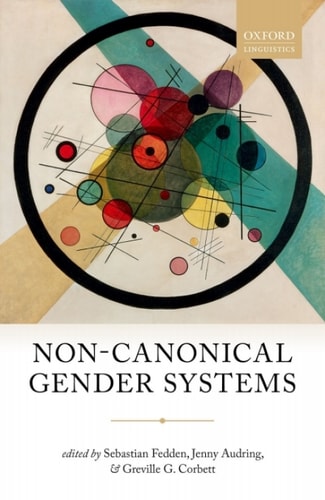
Non-Canonical Gender Systems
0
0
As an Amazon Associate and affiliate partner, Menrva Books earns from qualifying purchases. Learn more
Author Description
This book explores the boundaries of the category of gender and their theoretical significance within the framework of Canonical Typology. Grammatical gender is a famously puzzling category: although it has been widely explored from a typological perspective, studies are constantly identifying exciting and unexpected patterns in gender systems, many of which cannot be easily classified or straightforwardly analysed. Some of these patterns stretch or even threaten to cross the largely unexplored outer boundaries of the category. In the canonical approach, morphosyntactic features like gender are established in terms of a canonical ideal: the clearest instance of the phenomenon. The canonical ideal is a clustering of properties that serves as a baseline to measure the actual examples observed. In this volume, international experts use this approach to analyse a range of gender systems that diverge from the canonical ideal, and to determine to what extent each component property of these systems can be considered canonical. Chapters explore a wide range of typologically diverse languages from all over the world, from South America to Melanesia, and from Central Italy to Northern Australia. The book will be of interest to all linguists working in the field of typology, from graduate level upwards, as well as to morphologists and syntacticians of all theoretical stripes who have an interest in grammatical gender.
Menrva's Summary
THE THESIS
This volume investigates the theoretical boundaries of grammatical gender by examining systems that diverge from the canonical ideal. The authors, led by Greville G. Corbett, utilize the framework of Canonical Typology to evaluate how various non-canonical gender systems function across diverse global languages. By establishing a baseline of canonical properties, the contributors analyze the extent to which specific linguistic features deviate from this ideal, providing a structured method for classifying complex or unexpected gender patterns.
THE SCOPE MAP
What You Will Find
- Analysis of gender systems in languages from South America, Melanesia, Central Italy, and Northern Australia
- Application of the Canonical Typology framework to morphosyntactic features
- Comparative studies of non-canonical gender manifestations
Scope Limits
- The text does not provide a general introduction to basic linguistic gender for undergraduate students
- It does not cover sociolinguistic or historical gender evolution outside the scope of typological classification
THE AUTHORITY PERSPECTIVE
Experts identify this work as a significant contribution to typological research, particularly for its rigorous application of the canonical approach to complex linguistic data. Readers frequently note the academic density of the prose, making it most suitable for graduate-level linguists, morphologists, and syntacticians.
Page Count:
304
Publication Date:
2018-01-01
Publisher:
OUP Oxford
ISBN-10:
0192514784
ISBN-13:
9780192514783
Syntax
Academic
Grammar
Linguistics
English & College Success
Typology
English
Morphology